
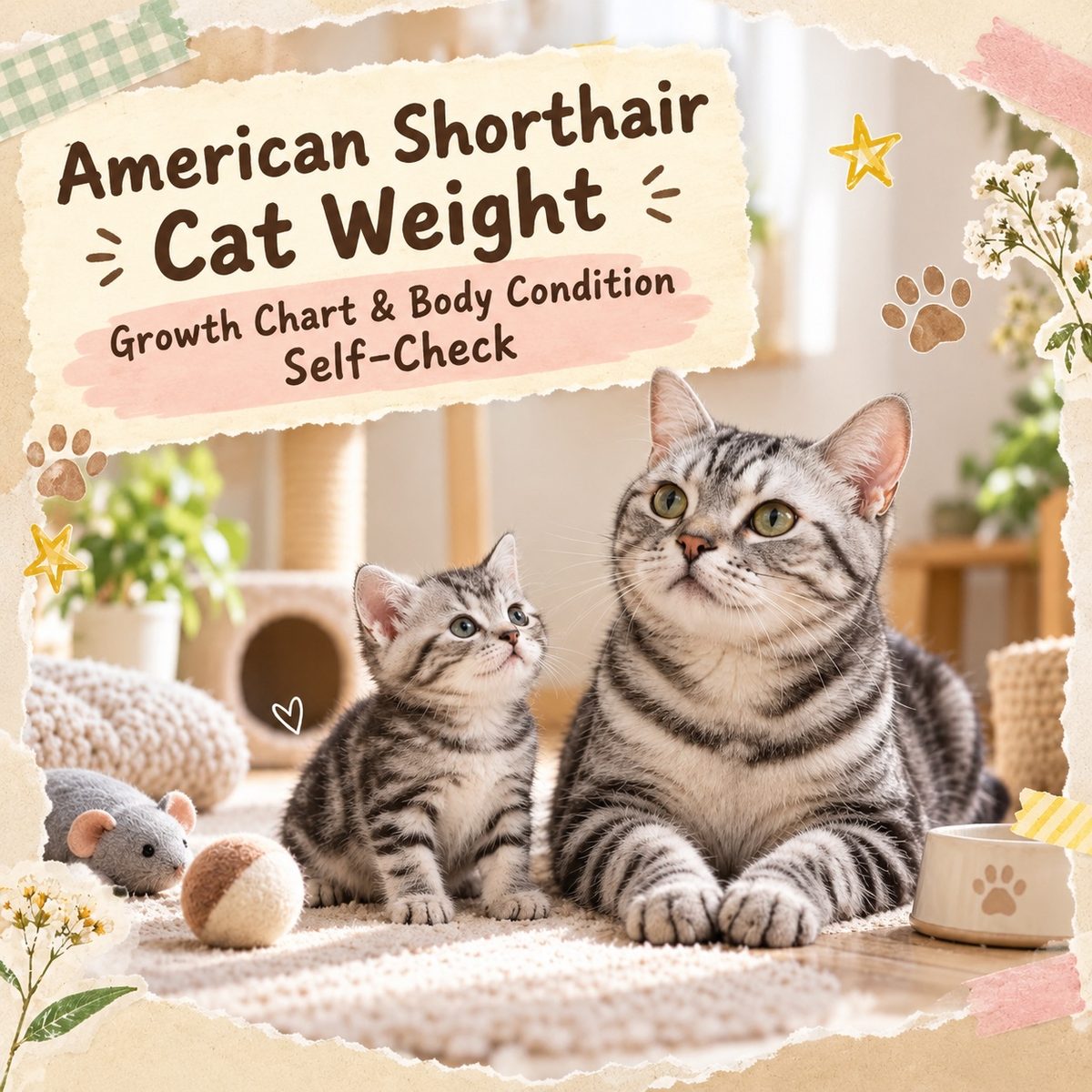
Quick answer: Adult American Shorthair weight is generally 5–8 kg for males and 4–5.5 kg for females; they are a muscular, large-framed breed. But 'how many kilograms is right' is actually the wrong question—the correct approach is to use body condition scoring (BCS) to judge fat or thin: feel the ribs, look at the waistline. American Shorthairs do not show fat obviously, so weighing plus hands-on checking once a month is the reliable method.
Want to know the American Shorthair inside out? Start with the American Shorthair breed profile.
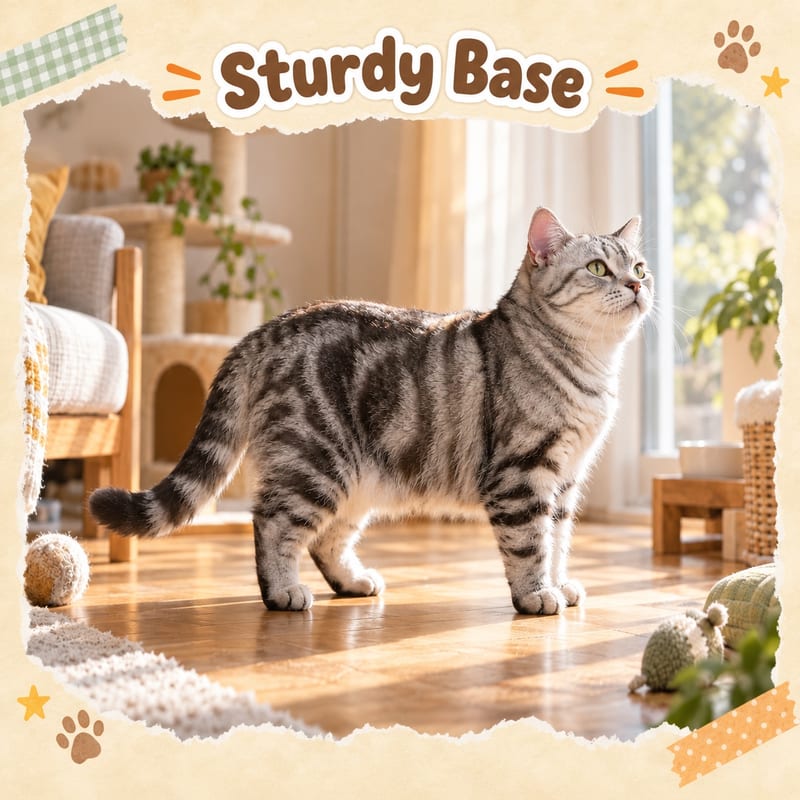
American Shorthair body type: the 'solid' chassis of a farm cat
The CFA breed standard describes the American Shorthair as medium to large, muscular, and well-proportioned—the keyword for this breed is not 'big' but 'solid'. Put an American Shorthair and a British Shorthair of the same kilogram weight side by side, and the American Shorthair usually looks leaner with a clearer waistline; the British Shorthair develops sideways, matures slowly, and can weigh over 9 kg. So for those searching 'British Shorthair weight chart' or 'British Shorthair weight standards' and applying them to American Shorthairs, the most practical tool is not a number table but the body condition scoring method below.
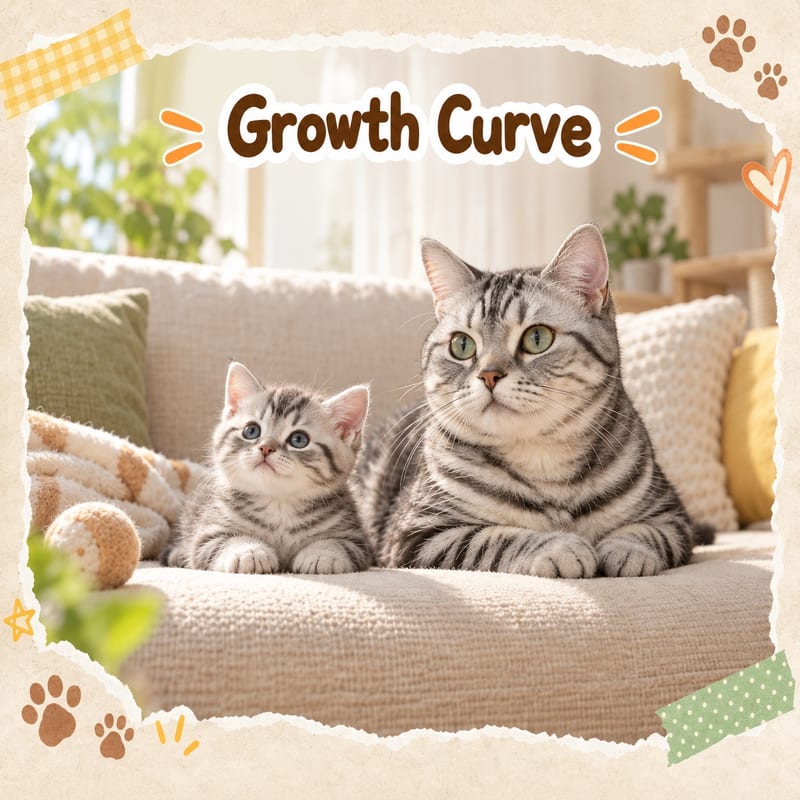
Kitten to adult weight growth chart
The following are general ranges (individuals are affected by bloodline and bone mass):
| Age | Weight reference (kg) | Development focus |
|---|---|---|
| 8 weeks | 0.8–1.0 | Window for completing first two vaccinations |
| 3 months | 1.3–1.8 | Baby teeth start being replaced by permanent teeth |
| 6 months | 2.5–3.5 | Recommended neutering period (consult veterinarian) |
| 9 months | 3.5–4.5 | Growth rate slows |
| 12 months | 4.0–5.5 | Approaching adult weight |
| 2–3 years | Male 5–8 / Female 4–5.5 | Muscle and chest width continue to set |
Growth rhythm is more important than absolute numbers: healthy kittens gain about 70–100 grams per week; if the curve stalls for two weeks or weight drops, that is a signal to see a veterinarian, not a case of 'wait and they'll catch up'.
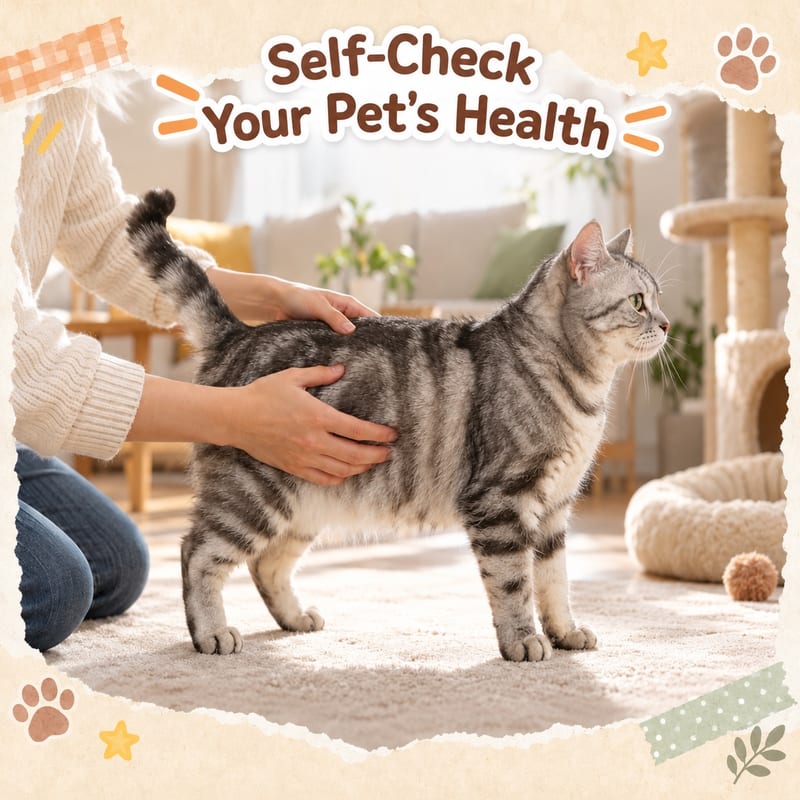
Body condition score (BCS): a 30-second self-check
The internationally common 9-point body condition score is widely used in veterinary clinics; you can use the same logic at home:
| Score | Ribs | Waistline | Abdomen | Interpretation |
|---|---|---|---|---|
| 1–3 | Visible at a glance | Extremely sunken | Clearly tucked up | Underweight, see veterinarian |
| 4–5 | Felt with light pressure | Visible from above | Slightly tucked | Ideal |
| 6–7 | Requires firm pressure | Disappeared | Starting to sag | Overweight, adjust feeding |
| 8–9 | Cannot feel | Impossible to judge | Clearly sagging pouch enlarged | Obese, veterinarian-guided weight loss |
Note: the 'primordial pouch' (a loose flap of skin under the abdomen) in neutered cats is easily confused with obesity—the primordial pouch is a hanging flap that sways when moving, and the ribs can still be felt; true fat is a layer of fat covering the ribs, which require firm pressure to feel. The two can coexist, so weighing and scoring on a fixed day each month, in a fixed state (morning before eating), is the only way to draw a trend.
Measurement methods: doable even without a pet scale
- Hold-and-weigh method: weigh yourself and note the weight, then hold the cat and weigh again; the difference is the cat's weight—error can be controlled within one or two hundred grams.
- Hands-on check-in: feel the ribs and look at the waistline at the same spot each month; take two photos with your phone, one from the side and one from above, for comparison.
- Neck circumference reference: use a soft tape to measure the middle of the neck (not behind the head); short-term changes can help reflect fat fluctuations, but long-term trends are still mainly based on weight.
Feeding adjustments after neutering: the most common turning point for weight gain
American Shorthairs are naturally prone to obesity, and metabolism drops after neutering (generally considered to decrease by about 20%); this is where most cats start becoming overweight. A safe approach: start 2–4 weeks after neutering, reduce daily calories by about 10% (measure portions, not by intuition), or switch to a weight management formula; do not do drastic 'half the kibble' operations—cats respond to sudden portion cuts with stress and increased begging behaviour. Pair with two play sessions daily—for American Shorthairs, burning energy not only prevents fat but also prevents destructive behaviour and anxiety.
Safe weight loss line: slow is the only way
Cats are different from dogs: rapid weight loss in cats carries a risk of fatty liver (hepatic lipidosis); do not starve, do not use extremely low calories. The safe weight loss rate for overweight cats is 0.5–2% of current body weight per week, which usually translates to about a 10% calorie reduction, combined with portion control and exercise; during weight management, re-weigh every two to four weeks, and the ideal curve is a smooth decline. Overweight cats should also be checked for thyroid and joint problems—older cats that are 'too fat to move' sometimes have joint pain and refuse to move, not because they ate too much; in these cases, see a veterinarian first.
Comparison with British Shorthairs: same kilograms, different substance
Those searching 'British Shorthair weight chart' often ask: my American Shorthair weighs the same as my friend's British Shorthair, why does mine look fatter? The answer lies in muscle density distribution: British Shorthairs have round heads, chubby cheeks, and wide bodies; fat tends to wrap evenly around the whole body. American Shorthairs have muscle concentrated in the shoulders, chest, and hind legs; once overweight, fat preferentially accumulates in the abdomen and rib layer, and the waistline disappears first. So the management tools are the same for both (BCS + trend line), but the order of signals differs: American Shorthair owners should especially watch for the early signal of 'waistline disappearing'; by the time the belly sags, the cat is usually already at 7 points or above.
Food intake, exercise, and weight: three tiers of daily management
Turn 'don't get fat' from a slogan into an operation; choose a tier according to your lifestyle: Basic tier (two fixed meals a day + food scale + monthly weight trend) suits first-time cat owners; Advanced tier adds puzzle feeders (70% of dry food into toys, making mealtime itself energy-burning) and one scheduled play session daily, suits 9-to-6 workers; Active tier adds two play sessions daily, higher wet food proportion, and weighing every two weeks, suits cats already assessed as overweight or post-neutering. The only red line common to all three tiers: do not use 'free feeding' for American Shorthairs—this breed generally has poor self-control; food in the bowl is a recipe for obesity. Also recommend a pet-grade electronic scale (a few hundred dollars is enough); no need for a dedicated app—a piece of paper and a pen, consistency is the key.
Height, body length, and jumping radius: numbers for space planning
Beyond weight, the American Shorthair's space needs have several quantifiable references: adult body length (nose to tail base) is about 45–60 cm, and with the tail the total length can exceed 80 cm—so the assumption of 'small enough to ignore' must be cancelled; standing jump height is generally five to six times shoulder height, so tabletops and fridge tops are always 'open doors' to them; dangerous items must be stored in cabinets, not on tables; vertical climbing frames with 30–40 cm spacing between levels best suit their leg length. Also note: after neutering, the American Shorthair's activity level quietly declines; if you do not actively add playtime, the formula of 'same food intake, less energy expenditure' will show on the weight curve within six months—body management for this breed must be written into the schedule from day one.

Frequently asked questions
Q: What is a normal weight for an American Shorthair in kilograms? A: Males 5–8 kg and females 4–5.5 kg are common ranges, but judge by body condition score, not just the scale number.
Q: How do I know if it is overweight? A: If you cannot feel the ribs with light pressure and there is no waistline from above, it is heading overweight; use the 9-point comparison table to score once a month.
Q: At what age is it fully adult? A: Around one year it approaches adult weight; muscle and chest width develop until 2–3 years; slower growth in solid breeds is normal.
Q: Can I starve a cat to make it lose weight? A: Absolutely not. Rapid weight loss carries a risk of fatty liver; the safe line is 0.5–2% body weight loss per week, under veterinary supervision throughout.
Q: What counts as normal growth for a kitten? A: About 70–100 grams gain per week; if the curve stalls for two weeks or weight drops, book a veterinarian immediately.
Q: Primordial pouch or fat belly? A: A swaying skin flap with ribs still feelable is the primordial pouch; fat covering where ribs require firm pressure to find is overweight. The two can coexist.
Key summary
- ✅ Common American Shorthair weights: male 5–8 kg, female 4–5.5 kg; muscular frame, numbers for reference only.
- ✅ Monthly fixed body condition scoring (4–5 on the 9-point scale is ideal) plus weighing to draw a trend is more reliable than a single weight.
- ✅ Reduce calories by about 10% within 2–4 weeks after neutering; this is the most common turning point for weight gain.
- ✅ Weight loss of 0.5–2% per week is the safe zone; starving cats risks fatty liver, never be drastic.
- ✅ Waistline disappearing is the earliest sign of overweight in American Shorthairs; waiting until the belly sags is usually too late.
Related reading
- American Shorthair disadvantages and how to cope
- American Shorthair lifespan and longevity guide
- American Shorthair personality and intelligence analysis
- Pet scales, portion-control bowls, and energy-burning toys: see the weight management series at PetChill pet supplies.
The growth numbers in this article are general reference ranges; individual variation is large. Weight management and weight loss plans should be carried out under the guidance of a registered veterinarian.



