
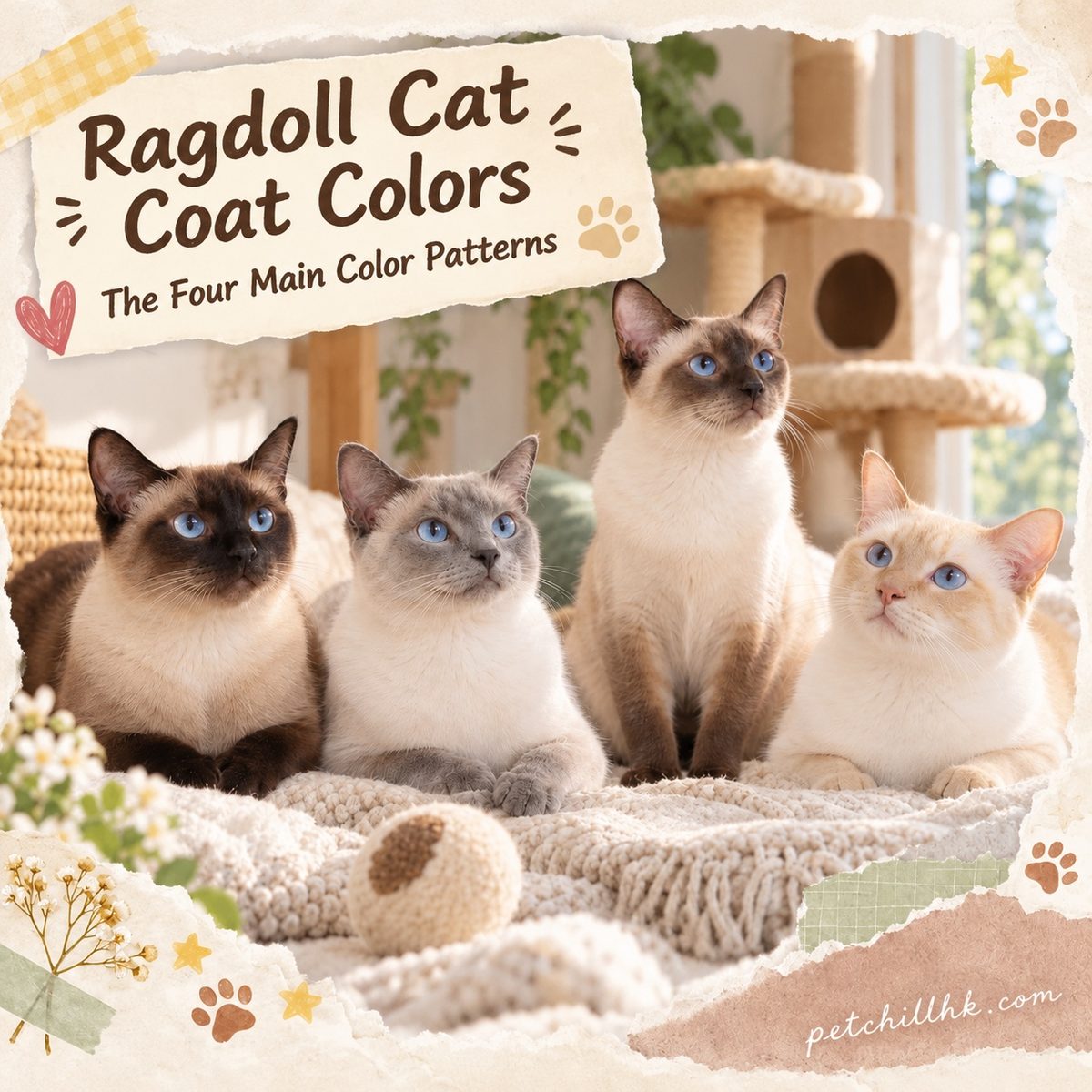
Quick answer: The Siamese cat has four recognised point colours: seal, red lynx, blue and chocolate, plus pattern variants such as lynx (tabby markings) and torbie (tortoiseshell markings). Siamese coat colour is determined by temperature-sensitive enzymes, so ears, nose, tail and paws get darker the colder they are; kittens only settle at two to three months, and adults still adjust slightly with the seasons. If you buy a light colour, pay attention to tear-stain grooming; with dark colours, watch for loss of contrast. This article breaks down each colour for you.
Want to know the Siamese cat inside out? Start with the Siamese breed profile and the complete Siamese cat guide.
What kind of cat is the Siamese? Key points in 30 seconds
The Siamese is a short-haired breed originating in Thailand, with three signatures: blue almond eyes, point colour and a wedge-shaped head. Coat colour is only one side of it; personality and needs are the key to deciding whether it suits you:
| Item | Siamese |
|---|---|
| Origin | Thailand (formerly Siam) |
| Average lifespan | 12–15 years |
| Weight | Male 4–5.5 kg / Female 3–4 kg |
| Coat | Short, single layer, moderate shedding |
| Eye colour | Blue (common to all colours) |
| Vocalisation | Frequent and loud, a breed trait |
| Tolerance of being alone | Low (prone to separation anxiety) |
| Hong Kong price | About HK$8,000–20,000 |
| Monthly basic expenses | About HK$800–1,500 |
Three basics you must know:
- Point colour changes — white as a kitten, darker as an adult, darker still in winter; all normal physiology, not a mutation.
- Colour does not affect personality — the difference between seal and blue is only appearance; interaction needs are exactly the same.
- 'Black ears and white body' is not exclusive to the Siamese — identifying the breed requires head shape, body type and pedigree documents.
Siamese cat prices and monthly expenses (2026 Hong Kong market)
Purchase prices differ between colour groups, but far less than people imagine. The table below shows actual Hong Kong market ranges:
| Item | Range | Notes |
|---|---|---|
| Registered cattery (seal) | HK$12,000–18,000 | Most common colour, largest supply |
| Registered cattery (blue/chocolate) | HK$13,000–20,000 | Less supply, longer waiting lists |
| Registered cattery (red lynx) | HK$14,000–20,000 | Males scarce, premium possible |
| Licensed pet shop | HK$8,000–15,000 | Check vaccination records and source |
| Adoption | HK$0–2,000 | Mostly pointed mixed breeds, already neutered |
| First-year vaccinations (three doses) | HK$900–1,500 | Annual booster thereafter |
| Neutering | HK$1,500–3,500 | Cheaper for males, more for females |
| Monthly food | HK$350–700 | Dry and wet mixed |
| Monthly cat litter | HK$120–250 | Clumping or tofu litter |
| Monthly total | About HK$800–1,500 | Excludes emergency medical costs |
A colour premium is not worth chasing: putting the extra HK$2,000 towards an individual with complete parental health screening gives a far better return than spending it on a rare colour.
What kind of person is a Siamese cat suitable for?
| Owner type | Suitability | Reason |
|---|---|---|
| Works from home / semi-retired | Very suitable | Plenty of company; vocalisation and clinginess become advantages |
| Two-person household with shifts | Suitable | Someone is home for long periods; loneliness stress is manageable |
| Single, 9am–9pm | Not recommended | Left alone over 8 hours a day on average; high risk of separation anxiety |
| Family with children | Needs assessment | Tolerant but dislikes being held; teach children interaction boundaries |
| Rented flat / public housing | Needs assessment | Loud calls carry; neighbour complaints are a real risk |
Reverse self-check (three questions):
- How many hours a day is someone at home?
- Can you accept being woken at night for several months?
- Do you have a monthly medical reserve of HK$200–500?
If you can't answer 'yes' to two of the three, consider another breed, or keep two cats together for company.
Siamese cat compared with other pointed cats
| Breed | Coat length | Vocalisation | Clinginess | Commonness in Hong Kong |
|---|---|---|---|---|
| Siamese | Short | High | Very high | High |
| Balinese | Medium-long | Medium-high | High | Low |
| Oriental Shorthair | Short | High | High | Medium |
| Snowshoe | Short | Medium | High | Very low |
| Pointed mixed domestic cat | Short | Medium | Variable | Common in adoption |
If you want Siamese interaction but fear the noise: a pointed mixed domestic cat is the practical answer, adoption fee HK$0–2,000, but you must accept that personality cannot be predicted.
Four common misconceptions about Siamese cats
| Misconception | Reality |
|---|---|
| The darker the point colour, the more purebred | Depth is related to body temperature, age and season, not directly to purity |
| Siamese cats are always aggressive | They are generally affectionate; biting usually stems from over-excited play, insufficient socialisation or pain |
| Blue eyes mean Siamese | Blue eyes can be caused by albino genes or other point-colour genes; check pedigree documents |
| Short hair needs no grooming | They still shed heavily in shedding season; brushing twice a week is still needed |
Siamese cat health check schedule: what to test and when
The three areas to watch in Siamese cats are urinary tract, digestion and teeth. Regular checks are far cheaper than fixing problems after they occur:
| Age | Recommended items | Approximate cost |
|---|---|---|
| 2–4 months | First-year vaccinations (three doses) + deworming | HK$900–1,500 |
| 6 months | Pre-neutering blood test + neutering | HK$2,000–4,000 |
| 1 year | Annual check-up + vaccination booster | HK$500–900 |
| 2–6 years | Annual check-up; urine test from age 3 | HK$600–1,200 |
| 7 years and over | Every six months: blood test, urine test, thyroid | HK$1,200–2,000 per visit |
Three daily observations (free but must be done every day):
- Water intake: a sudden big increase or decrease may be a urinary/kidney signal.
- Litter tray: frequent visits with little urine, or crying in pain, is an emergency signal; do not wait.
- Weight: weigh once a month; a loss of more than 5% in a month means see a veterinarian.
Three budget plans: thrifty, standard, secure
The same Siamese cat can be kept three ways. The key is to choose in advance, not to discover a shortfall after something happens:
| Item | Thrifty | Standard | Secure |
|---|---|---|---|
| Food | HK$350/month (mainly dry) | HK$500/month (dry and wet) | HK$700/month (mainly complete wet food) |
| Cat litter | HK$120/month | HK$180/month | HK$250/month |
| Deworming (shared) | HK$80/month | HK$100/month | HK$150/month |
| Medical reserve | HK$0 (rely on cash) | HK$200/month | HK$500/month |
| Extras | — | Annual check-up | Six-monthly check-up + pet insurance |
| Monthly total | About HK$550 | About HK$980 | About HK$1,600 |
| Suitable for | Tight budget with cash reserve | Most families | Those wanting to avoid sudden large bills |
Insurance or own reserve? Hong Kong pet insurance annual premiums are generally HK$1,500–4,000 depending on age and cover, with excess and caps. If you already have HK$20,000 or more in liquid cash, your own reserve is usually more flexible; if not, insurance is a tool to spread sudden risk. Pick one.
Whatever the budget, remember to include tear-stain supplies for light-coloured cats (chocolate, blue) — wet cotton pads, eye cleaning solution, about HK$50–100 a month — in regular expenses, and don't wait until the marks become stubborn stains.
Another easily overlooked item is grooming tools: a short-haired cat brush at HK$60–150 can last ten years, the best value purchase in your whole cat-keeping life.
1. First understand the principle: why the Siamese is 'pointed'
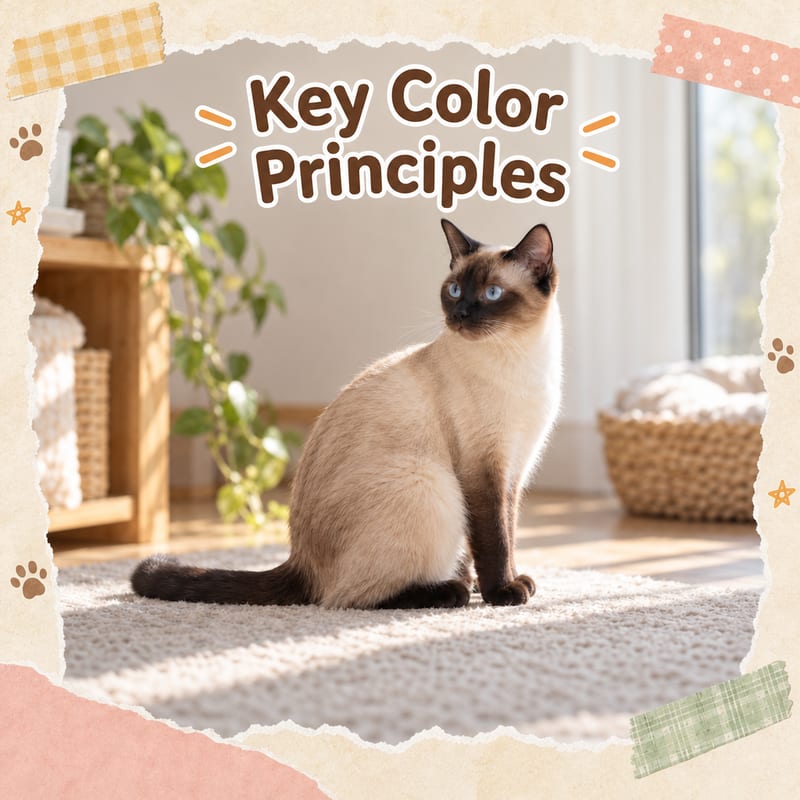
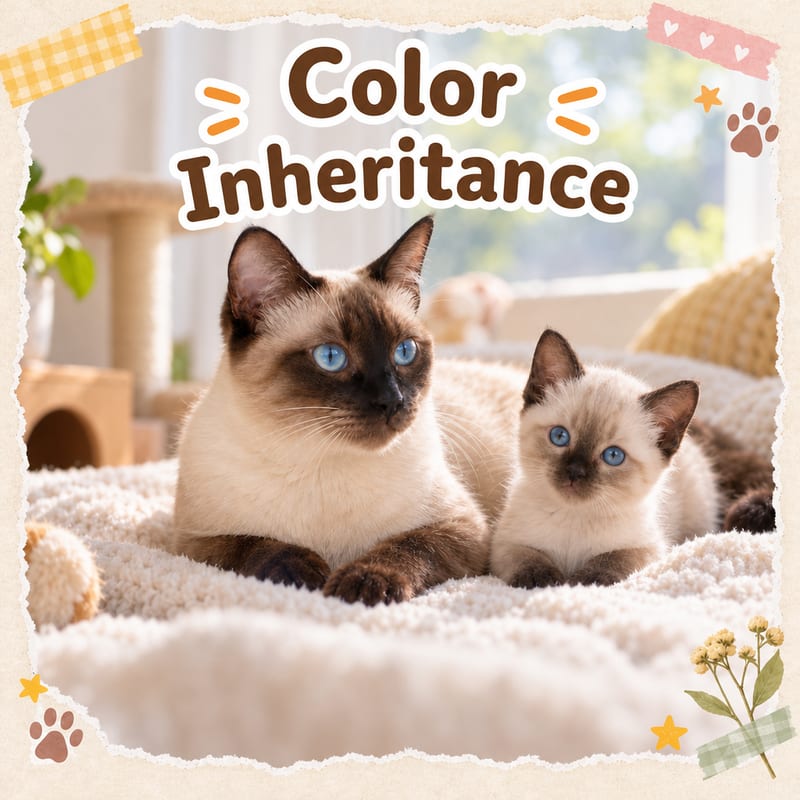
The Siamese's signature look — a milk-white body with dark ears, mask, limbs and tail — comes from a genetic mechanism: the enzyme controlling melanin synthesis (tyrosinase) is temperature-sensitive and only works at the cooler extremities, while the warm torso stays light. This mechanism explains three common questions: why newborn kittens are all snow-white (constant temperature in the womb), why the colour deepens in winter (colder extremities), and why a feverish or bandaged area turns 'white' (local warming). Because of this, 'pointed' is not exclusive to the Siamese — Balinese, Oriental Shorthair, Snowshoe and some domestic cats carry the same gene; to identify a true Siamese, look at head shape, body type, eye shape and pedigree documents, not just 'black ears and white body'.
2. Overview of the four traditional colours
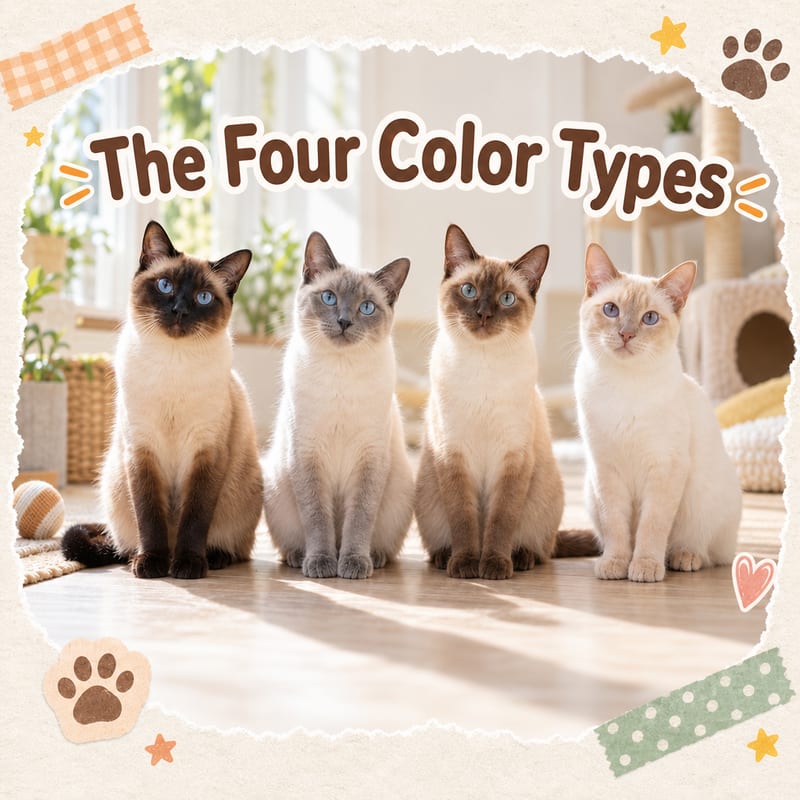
| Colour | English name | Body colour | Point characteristics | Nose leather/paw pads | Commonness in Hong Kong |
|---|---|---|---|---|---|
| Seal point | Seal Point | Creamy white to light fawn | Dark brown almost black, strongest contrast | Dark brown | Highest |
| Blue point | Blue Point | Grey-white | Blue-grey with silver tone | Slate grey | Medium |
| Chocolate point | Chocolate Point | Ivory white | Milk-cocoa colour | Pale flesh pink with brick-red edge | Medium-low |
| Red lynx point | Red Lynx Point | Milky white with warm tone | Orange-red tabby markings | Pink | Lower |
Seal point is the most classic and closest to the appearance depicted in ancient Thai texts; it is usually the one people recognise at first glance as 'this is a Siamese cat'. Chocolate point is often mistaken for a 'faded seal', but they are different genetic combinations, and in kittenhood they are the hardest pair to tell apart — wait until the colour stabilises after three months before drawing conclusions.
Siamese cat colour quick-reference table: identification keys, care focus and Hong Kong prices
| Colour | Identification key (point colour + nose leather and paw pads) | Care focus | Commonness in Hong Kong | Registered cattery reference price |
|---|---|---|---|---|
| Seal point | Dark brown almost black, nose leather and paw pads dark brown | Brushing is enough, 1–2 times a week | Highest | HK$12,000–18,000 |
| Blue point | Blue-grey with silver tone, nose leather and paw pads slate grey | Silver undercoat shows dandruff easily; watch skin moisture | Medium | HK$13,000–20,000 |
| Chocolate point | Milk-cocoa colour, nose leather and paw pads pale flesh pink with brick-red edge | Tear stains most obvious on light mask; dry-wipe eye corners daily | Medium-low | HK$13,000–20,000 |
| Red lynx point | Orange-red tabby markings, nose leather pink | Warm-toned coat fades in sun; draw curtains if by a window for long periods | Lower | HK$14,000–20,000 |
To identify colour, look at two things first: depth of point colour and nose leather and paw pad colour; only together are they accurate. The price difference between the four colours is limited; what really affects price is whether health screening documents are complete, not rarity.
3. Pattern variants: lynx point, torbie point and the extension of point colours
TICA's expanded recognised pattern variants include: lynx point — points with clear stripes and an M mark on the forehead, most commonly seal lynx and red lynx (i.e. the red lynx point in the table above); torbie point and tortie point — points with mixed cream/orange patches, genetically almost all female; blue cream point and other rare dilute tortoiseshell combinations. These variants have more patterned coats, but breed temperament, care and health follow the same Siamese standard. Also be aware of two 'near colours': smoke and pale silver shaded Siamese are experimental colours in some registries and not traditional; where the market charges more for a 'rare colour', checking the pedigree documents against the recognised range is the only way to avoid being fooled.
4. Colour changes: season, age and the truth about 'getting darker with age'
Many owners are alarmed to find their Siamese 'getting darker and darker': the mask spreads and the creamy body turns beige. This is normal and follows three curves: kittenhood (rapid colour development within two to three months), young adult (stable, slight seasonal variation), and middle to older age (point colour continues to deepen with age, and body colour also gradually changes). Long periods in air-conditioning at low temperature can accelerate overall darkening; this is an environmental effect, not a health problem. The opposite signals are the ones to watch: point colour suddenly fading, patchy fading, or local 'white patches' at injured or feverish areas — have the veterinarian assess these together with the overall condition. A word on eyes: all four colours have blue eyes; the purer and deeper the blue, the more it meets the breed standard. Cloudy eyes or a change of colour on one side should be seen promptly.
5. Care differences by colour: light colours show marks, dark colours show skin
| Colour | Grooming focus | Recommended frequency |
|---|---|---|
| Seal | Dark brown oils show on light undercoat; brushing is enough | 1–2 times a week |
| Blue | Silver undercoat shows dandruff easily; watch skin moisture | 1–2 times a week |
| Chocolate | Tear stains most obvious on light mask; wipe eye corners frequently | Dry-wipe daily, wet-wipe weekly |
| Red lynx | Warm-toned coat fades in sunlight; draw curtains if by a window for long periods | Brush weekly + monitor for sun fading |
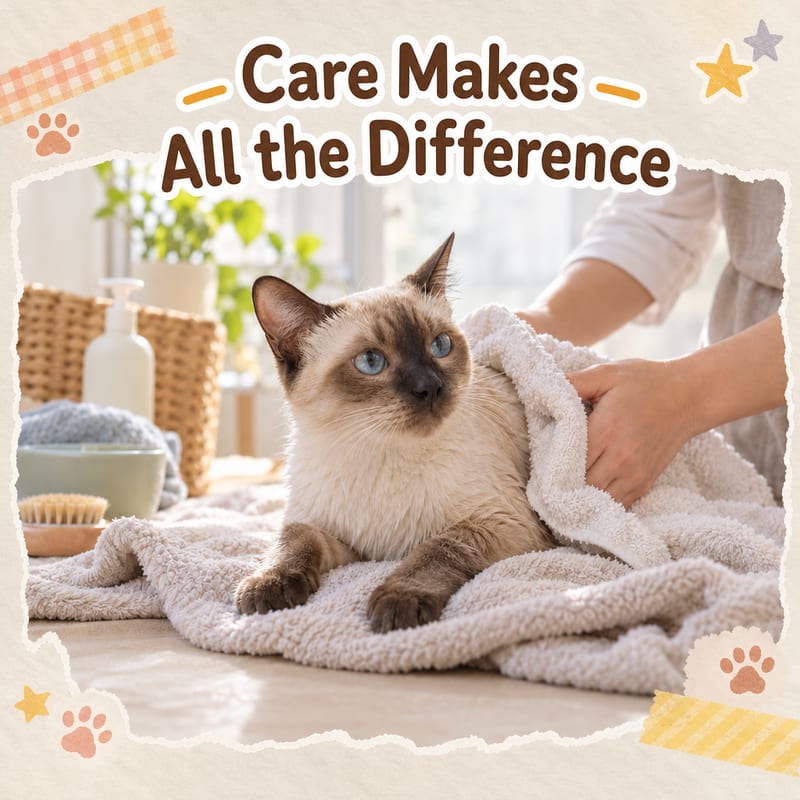
Beyond the coat, all four colours are identical: short hair, moderate shedding, no need to bathe more often than necessary. The only real 'colour cost' is appearance management — tear stains and saliva oxidation (red-brown chin) are more obvious on light-coloured cats; regularly wiping the chin after meals and the eye corners with wet cotton pads is enough. If it won't wipe off and is accompanied by yellow-green eye discharge, that is a sign of infection, not just a grooming issue, and you should see a veterinarian.
6. Colour and genetics: breeding knowledge + a practical answer to 'which colour is most expensive'
Three practical conclusions from introductory genetics: point colour is a recessive gene, so both parents must carry it for a whole litter of pointed kittens; the red (orange) gene is on the X chromosome, so red lynx and tortoiseshell males are less common and rarer — this is exactly why some quotes say 'orange Siamese cost more than seal'; and a kitten's final colour can be roughly inferred from the parents' colours and nose leather colour, but not with 100% certainty. Back to price: colour premiums exist in the Hong Kong market but are generally small (red lynx and chocolate are generally considered slightly more expensive than seal), and health and temperament are no different in any colour — spending the premium on an individual with complete health screening is far wiser than spending it on a 'rare colour'. Finally, a practical tip for identifying colour: when meeting the cat, ask the seller to photograph it in natural light, to avoid yellow lighting 'turning' chocolate into seal; photograph the nose leather and paw pads together for reliable colour evidence. Pointed mixed-breed cats from adoption organisations are mostly not labelled by colour; conversely, if you are after a specific colour, lower your expectations when adopting; if you only want the 'blue eyes and black ears' look, the mixed-breed list offers more choices without a premium.
Frequently asked questions
How many colours do Siamese cats come in? Four traditional colours: seal, blue, chocolate and red lynx, plus pattern variants such as lynx and torbie.
Why do the ears and tail get darker? Due to temperature-sensitive enzymes; the cooler extremities synthesise more melanin. Cold weather and ageing both deepen it; it is a physiological phenomenon.
How do you tell seal from chocolate? Look at point colour depth and nose leather and paw pad colour together: seal is dark brown, chocolate is cocoa with a pink nose.
Is blue point rare? It is moderately common; rarity affects price, not health, so don't pay a premium for rarity.
When does a kitten's colour settle? All white at birth, roughly settled by two to three months, then still adjusting slightly with season and age.
Are white paws purebred? The traditional standard has no white gloves; the Snowshoe is another breed, white patches are common in mixed breeds, and it only affects certification, not health.
What colour is 'Siamese colour'? It means point colour — a light body with dark extremities, determined by temperature-sensitive enzymes; the traditional four are seal, blue, chocolate and red lynx.
What is the difference between a tabby Siamese and a traditional Siamese? Tabby Siamese means lynx point, with clear stripes on the points and an M mark on the forehead, most commonly seal lynx and red lynx (red lynx point).
Are pointed cats always Siamese? Not necessarily. Balinese, Oriental Shorthair, Snowshoe and some domestic cats are also pointed; identifying a Siamese requires head shape, body type and pedigree documents.
Key takeaways
- ✅ Four traditionally recognised colours: seal, blue, chocolate, red lynx; pattern variants depend on the registry's recognised range
- ✅ Point colour is determined by temperature-sensitive enzymes: darker when colder; white at birth and gradually darker in adulthood is normal
- ✅ To tell seal from chocolate, look at nose leather and paw pads; wait until kittens are over three months before concluding
- ✅ Light colours (chocolate, blue) need frequent wiping of tear stains and saliva marks; dark colours need checking for dandruff
- ✅ The orange gene makes red lynx males scarce; a premium is reasonable but not worth chasing
- ✅ 'Black ears and white body' is not unique to the Siamese: identifying the breed requires head shape, body type and pedigree documents
Related articles
- Siamese cat personality and intelligence explained
- Siamese cat disadvantages and how to cope
- Siamese cat price and adoption guide
- Complete Siamese cat guide
- How long do Siamese cats live? Genetic tendencies and a longevity checklist
- Siamese cat Hong Kong keeping guide: climate, buildings and companionship needs
- Siamese cat origin history: from Thai royal cat to international show cat
- Cat wet cotton pads, short-haired cat brushes and eye cleaning supplies: find them all at PetChill pet supplies.
The breed standard content in this article uses CFA/TICA public documents as general reference; individual recognised ranges are subject to the latest announcements of the relevant registry.



