
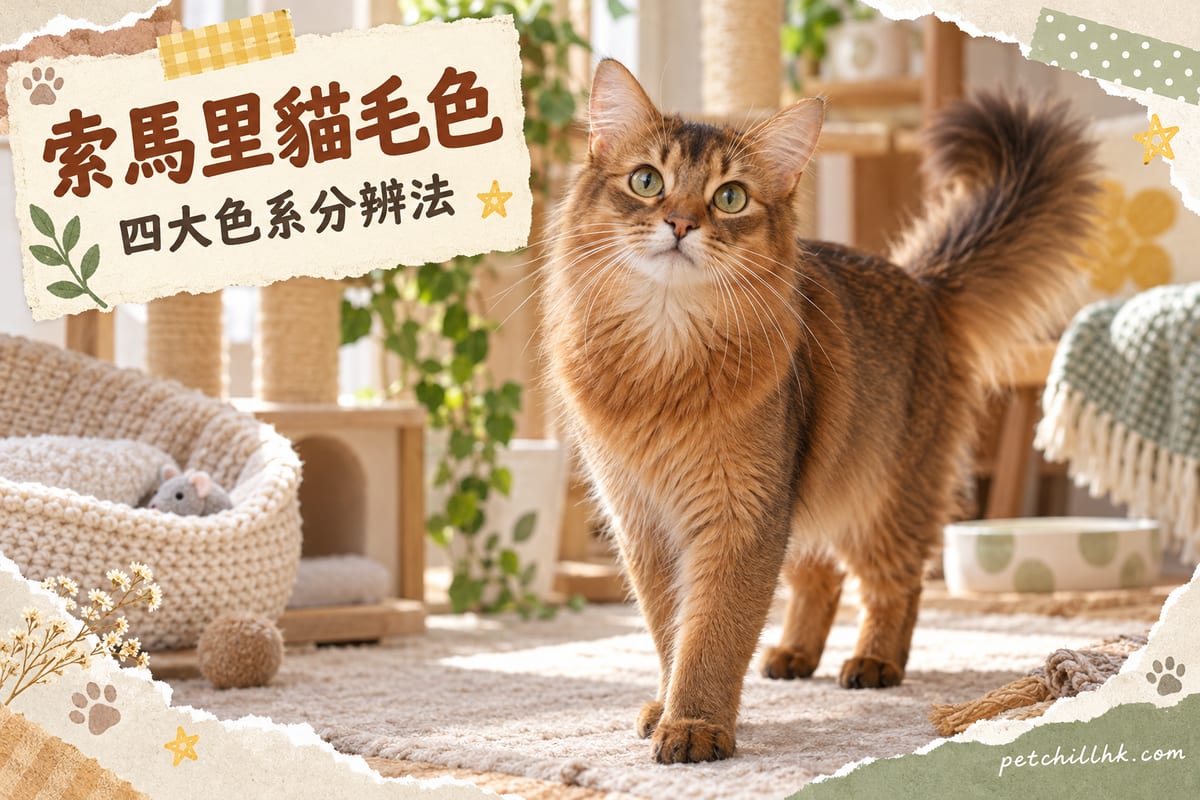
Quick answer: The Somali cat's most iconic feature is its ticked coat: each hair has a gradient from root to tip, giving an even ruddy metallic sheen rather than tabby stripes. There are four main recognised colour classes: ruddy, red, blue and fawn, with ruddy being the most classic. It does not come in pure black, because a ticked breed never shows large areas of solid colour.
Want to learn more about the Somali cat? Keep reading the series below.
1. Colour classes and commonness
| Colour class | Characteristics | Commonness |
|---|---|---|
| Ruddy | Dark brown tips, red-orange base, classic metallic sheen | Most common |
| Red (Sorrel) | Overall warm red-orange, less contrast between layers | Common |
| Blue | Grey-blue tone, light grey tips, warm base | Less common |
| Fawn | Pale cream to beige, soft and bright | Less common |
These are the main recognised colour classes. Because the Somali is a ticked breed, all colours come from light and dark gradients, with no solid colour or obvious stripes. Rarer colours (blue, fawn) are more sought after in the market, but this has no effect on the cat's health or grooming. Coat colour is completely unrelated to personality or health—different colours can appear in the same litter, and choosing a colour is purely personal preference. Ruddy is the most classic because it best shows off the ticked layers, looking like a warm golden glow from a distance; blue and fawn are rarer and less available, but that does not mean they are healthier or more purebred.
2. How does the ticked coat form?
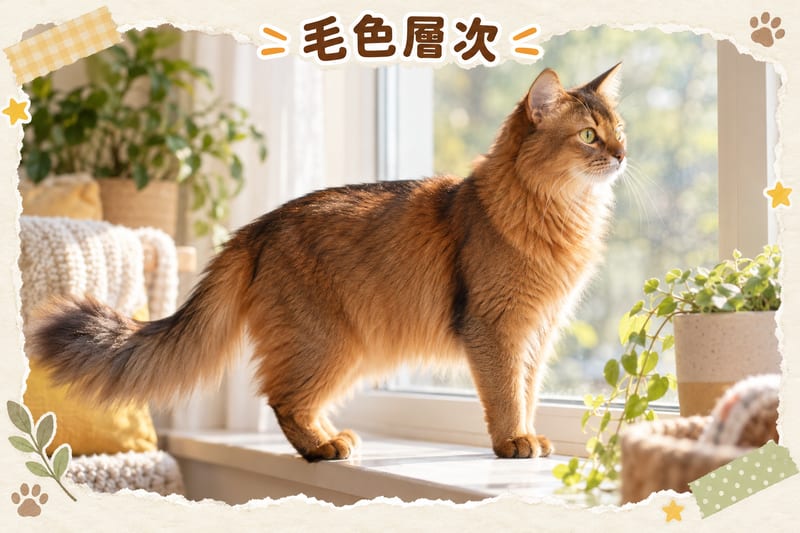
The principle of a ticked coat is: several bands of alternating light and dark pigment along a single hair, and when the hairs are neatly arranged, this creates an even metallic sheen that changes with the light. This feature makes the Somali cat look "golden and sparkling" in sunlight, and is why many people remember it at first sight. Combined with the semi-longhair coat and undercoat, the sheen is softer and more layered than the shorthaired Abyssinian. It is worth noting that the ticked coat is a breed hallmark and should not show obvious tabby stripes; if you see clear stripes, it is usually a mix or another breed. Also, the ticked effect changes with light and angle: it can look like two different tones with the light and against it, which is why many people think the Somali cat "changes colour". As for coat texture, the undercoat provides fluffiness while the longer outer coat is smooth, and the two layers together create the even sheen.
3. Differences from Abyssinian cat colours
People searching for "Abyssinian cat colours" often ask whether the Somali is the same. The answer is: the colour classes are basically identical, because the Somali is the longhaired version of the Abyssinian and the recognised colours are the same (ruddy, red, blue, fawn). There are two main differences: first, the Somali has a longer coat with an undercoat, so the ticked layers look softer and fluffier on the long coat; second, the long hair makes the sheen more even, giving a "misty glow" from a distance. So if you like the ticked coat but want a fluffier, softer texture, the Somali is the better fit. When actually choosing a cat, if you want a "shorthaired, neat" look, the Abyssinian is more suitable; if you want a "longhaired, soft, big-tailed" texture, choose the Somali. The price and health risks are similar; the real difference is appearance and grooming workload.
4. Common misconception: is there pure black?
A common misconception is whether Somali cats come in black. The answer is no—the ticked breed's colour comes from light and dark gradients, and never appears pure black or as a large solid block. This is consistent with the Abyssinian. Some longhaired black cats are sold as "rare Somali cats", but this confuses the breed—if you see an all-black longhaired cat with no ticked layers, it basically does not meet the Somali coat standard. To tell whether a cat is a Somali, the most direct way is to look at the coat: a true Somali has a gradient on every hair, with no large solid areas and no obvious stripes. Knowing the ticked features before buying can help you avoid being misled. Incidentally, ticked breed kittens sometimes have slight residual stripes that fade as they grow, which is normal.
5. Grooming differences between colour classes
| Colour class | Dust visibility | Stain visibility | Grooming focus |
|---|---|---|---|
| Dark (ruddy, blue) | Shows dust more easily | Less obvious | Brush often, keep fluffy |
| Light (fawn, red) | Less obvious | Shows stains more easily | Spot clean, avoid grease |
Whatever the colour, grooming is basically the same: brush 3–4 times a week for 5–10 minutes each time, and more often in shedding season. Dark colours show dust more easily, so brush more frequently; light colours show stains more easily, so pay attention to spot cleaning. These are all about appearance management; what really affects health is whether the undercoat is matted. For tools, prepare a slicker brush (for loose undercoat) and a comb (for smoothing the longer outer coat), and add a de-shedding tool in shedding season. The brushing order is: first smooth with the comb, then remove loose undercoat with the slicker brush, and finally check the armpits and base of the tail for missed spots.
6. How age affects coat colour
Kittens have a softer, lighter undercoat and gradually develop clearer ticked layers and metallic sheen as they grow, usually reaching their best condition at 1–2 years old. In old age the coat may become coarser and less shiny, which is normal ageing. If the coat suddenly becomes dull, patches of hair are lost or the skin is red and swollen, check whether it is a skin problem or nutritional deficiency, and consult a veterinarian early. Diet also affects keeping the coat looking good: enough protein and Omega fatty acids help coat shine, while malnutrition makes the coat dull and brittle. A quality staple food plus regular brushing is the most practical care method. Taking a photo monthly to record coat changes can also help spot abnormalities in shine or density early.
7. How to choose your preferred colour
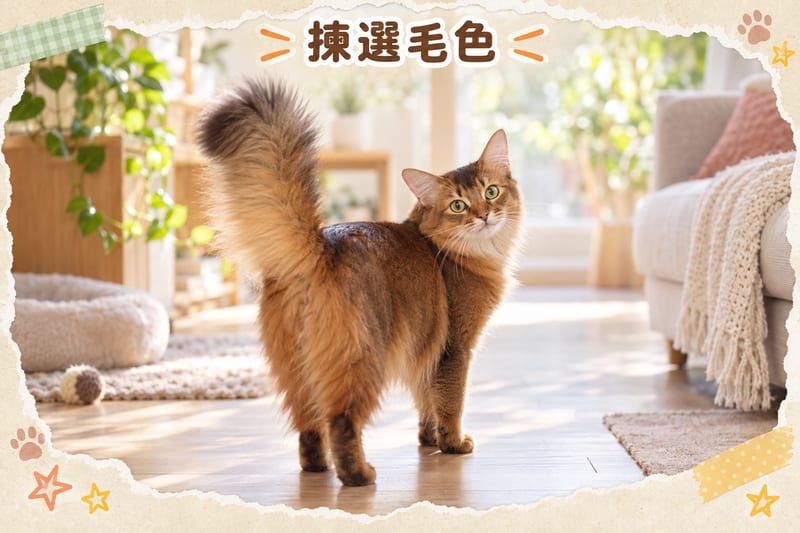
You can consider colour from three angles: 1. Light: in a home with plenty of natural light, ruddy and red stand out more; in dimmer light, fawn looks softer. 2. Grooming: dark colours show dust, light colours show stains, and the difficulty is similar, so don't avoid a colour just because of stains. 3. Rarity: blue and fawn are less available and may require waiting. Remember, coat colour is only appearance; health, personality and source documents are the core of choosing a cat. If you plan to show or breed, note that different cat associations have clear standards for recognised colours, so when choosing a cat it is best to check the colour registration on the pedigree documents.
Key points
- ✅ The Somali cat's hallmark is the ticked multi-tonal coat with a ruddy metallic sheen
- ✅ Main recognised colour classes: ruddy, red, blue, fawn, with ruddy the most classic
- ✅ Ticking gives each hair a gradient, with no obvious tabby stripes
- ✅ No pure black; an all-black longhaired cat is usually another breed
- ✅ Colour classes are the same as the Abyssinian; the long hair makes layers softer and fluffier
- ✅ Grooming is the same: brush 3–4 times a week, more often in shedding season
- ✅ Coat colour is an appearance trait; health still depends on skin and undercoat condition
Related reading
- Somali cat personality revealed
- Full list of Somali cat disadvantages
- Somali cat weight and size explained
- Slicker brushes, combs and hairball gel: get them all at PetChill pet supplies.
The coat descriptions in this article are general breed information; if you notice skin, hair loss or coat quality abnormalities, please consult a registered veterinarian.



