
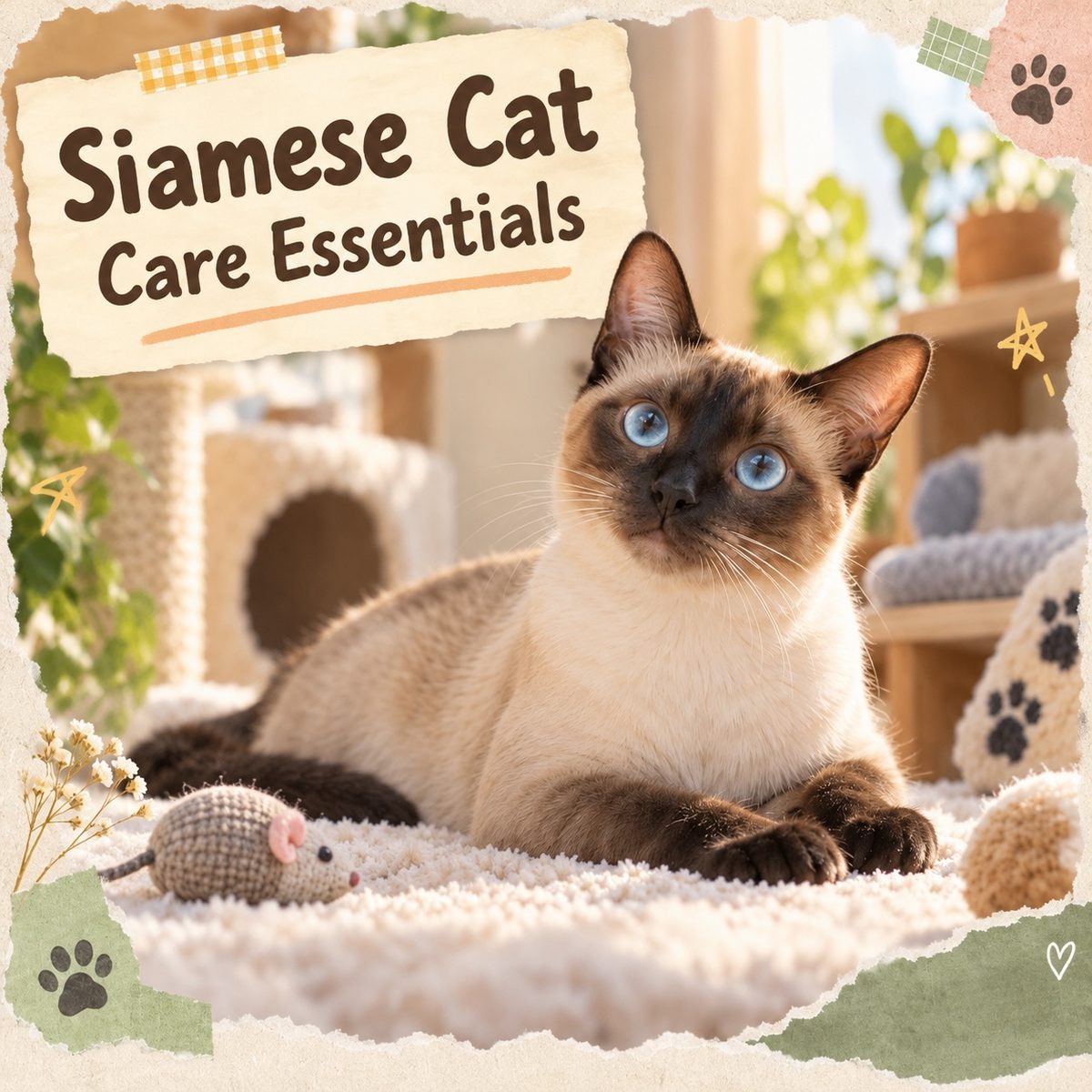
Quick answer: The core Siamese disadvantages are not 'difficult to care for' but high companionship needs, lots of meowing, easy boredom, and sensitive digestion and urinary tract. Short coat, easy grooming, high intelligence, and easy training are the compensations. Below are seven items with coping methods: families with plenty of time can avoid most of this list; for nine-to-nine households, read items 4 and 5 before deciding.
Want to know the Siamese cat inside out? Start with the Siamese breed profile and the Siamese cat complete guide.
What is a Siamese cat? 30-second summary
The Siamese is a short-haired breed originating from Thailand, known for its blue almond eyes, point colour (darker face, ears, legs, tail), and being 'talkative'. It is the ancestor of modern Oriental-type shorthairs, with extremely high social needs, and is not suited to long periods alone. The table below covers the specs Hong Kong owners look up most; the disadvantages and costs are broken down later.
| Item | Siamese |
|---|---|
| Origin | Thailand (formerly Siam) |
| Average lifespan | 12–15 years |
| Weight | Male 4–5.5 kg / Female 3–4 kg |
| Coat | Short, single coat, close-lying, moderate shedding |
| Voice | Frequent, loud (breed trait, not a behaviour problem) |
| Tolerance of being alone | Low (prone to separation anxiety) |
| Intelligence / trainability | High (can learn commands, walk on leash) |
| Hong Kong price | About HK$8,000–20,000 |
| Monthly basic costs | About HK$800–1,500 |
Three fundamentals you must know:
- 'Crazy talker' is not an illness — Siamese meowing is communication; those who want a quiet cat should choose another breed.
- Clinginess is a double-edged sword — the good side is closeness and easy training; the bad side is high risk of stress behaviours when alone.
- Short hair does not mean zero grooming — short single coats turn over quickly and still need brushing in shedding season, but it takes half the time of long-haired breeds.
Siamese cat price and monthly costs (2026 Hong Kong market)
Price is only the entry fee; the real decision driver is monthly fixed expenses. The table below shows actual Hong Kong price ranges; figures are for reference only—ask about each item before ordering.
| Item | Range | Notes |
|---|---|---|
| Registered cattery | HK$12,000–20,000 | With pedigree certificate and parent health screening records |
| Licensed pet shop | HK$8,000–15,000 | Point colour depth and vaccination records affect price |
| Adoption | HK$0–2,000 | Most already neutered and vaccinated |
| Vaccines (first-year three doses) | HK$900–1,500 | Annual booster thereafter |
| Neutering | HK$1,500–3,500 | Cheaper for males, more for females |
| Monthly food | HK$350–700 | Dry food plus complete wet food mixed |
| Monthly cat litter | HK$120–250 | Clumping clay litter / tofu litter |
| Monthly deworming (shared) | HK$80–150 | Internal and external |
| Medical reserve (recommended) | HK$200–500 | Urinary and digestive issues more likely |
| Monthly total | About HK$800–1,500 | Excluding major medical costs |
The item Hong Kong owners most often underestimate is the medical reserve. Siamese are sensitive in the urinary tract and digestion; one ultrasound plus blood test starts at HK$1,500, so saving HK$200–500 a month is practical, not conservative.
Who is a Siamese cat suitable for?
| Owner type | Suitability | Reason |
|---|---|---|
| Work from home / semi-retired | Very suitable | Plenty of companionship time; meowing and clinginess become advantages |
| Two-person shift household | Suitable | Someone home for long hours; alone-time stress manageable |
| Single, nine-to-nine | Not recommended | Alone >8 hours a day on average; high separation anxiety risk |
| Families with children | Depends on age | Siamese tolerant but dislike being held; teach children |
| Rented flat / public housing | Assess | Loud penetrating call; neighbour complaints are a real risk |
Reverse self-test (three questions):
- How many hours a day is someone home?
- Can you accept being woken several times a night for months?
- Do you have a monthly medical reserve of HK$200–500?
If you cannot answer 'yes' to two of the three, it is time to consider another breed, or adopt two cats to keep each other company.
Siamese cat vs other shorthair breeds
| Breed | Noise level | Clinginess | Monthly basic costs | Beginner-friendly |
|---|---|---|---|---|
| Siamese | High | Very high | HK$800–1,500 | If you have time |
| British Shorthair | Low | Medium | HK$600–1,200 | Yes |
| American Shorthair | Low | Medium | HK$600–1,200 | Yes |
| Russian Blue | Low | Medium-high | HK$700–1,300 | Yes |
| Ragdoll | Low | High | HK$900–1,600 | Yes (long hair) |
In one sentence: want quiet, choose British Shorthair / Russian Blue; want interaction, choose Siamese; neither is better, only whether it fits your lifestyle.
Adopt or buy? The actual Hong Kong process
Adoption routes: SPCA, AFCD partner organisations, various cattery volunteer groups. The process is generally form → home visit → trial period → formal adoption, taking 1–4 weeks; most are already neutered and vaccinated, lowest long-term cost.
Purchase routes: registered catteries first (with parent screening records and traceable pedigree), licensed pet shops second. Three things to note: ① ask to see parent health screening documents; ② observe the cat's energy, eye/nose discharge, and skin condition on site; ③ before signing, clarify vaccination doses and deworming records.
First thing to do either way: find a feline-friendly veterinarian in advance and register a medical record. The first meeting should not wait until something goes wrong.
Siamese cat health check schedule: what to test when
The three areas to watch most in Siamese are urinary tract, digestion, and teeth. Regular checks are much cheaper than crisis care:
| Age | Recommended items | Approximate cost |
|---|---|---|
| 2–4 months | First-year vaccines (three doses) + deworming | HK$900–1,500 |
| 6 months | Pre-neutering blood test + neutering | HK$2,000–4,000 |
| 1 year | Annual check-up + vaccine booster | HK$500–900 |
| 2–6 years | Annual check-up; urine test from age 3 | HK$600–1,200 |
| 7+ years | Every six months: blood, urine, thyroid | HK$1,200–2,000 per visit |
Three daily observations (free but must be done daily):
- Water intake: a sudden big increase or decrease can signal urinary/kidney issues.
- Litter box: frequent visits with little urine, or crying in pain, is an emergency—do not wait.
- Weight: weigh monthly; a loss of more than 5% in a month warrants a vet visit.
Three budget plans: thrifty, standard, secure
The same Siamese can be kept three ways. The point is not which is 'right' but to choose in advance, so you don't discover a shortfall when something happens.
| Item | Thrifty | Standard | Secure |
|---|---|---|---|
| Food | HK$350/month (mainly dry) | HK$500/month (dry and wet) | HK$700/month (mainly complete wet food) |
| Cat litter | HK$120/month | HK$180/month | HK$250/month |
| Deworming | HK$80/month share | HK$100/month | HK$150/month |
| Medical reserve | HK$0 (rely on cash) | HK$200/month | HK$500/month |
| Extras | — | Annual check-up | Six-monthly check-up + pet insurance |
| Monthly total | About HK$550 | About HK$980 | About HK$1,600 |
| Suitable for | Tight budget, cash reserve | Most families | Avoiding sudden large expenses |
Insurance vs own reserve: Hong Kong pet insurance annual premiums are generally HK$1,500–4,000 (depending on age and coverage), with excess and caps. If you already have HK$20,000+ liquid cash, saving yourself is usually more flexible; if not, insurance is a tool to spread sudden risk. You don't need both.
Four common Siamese cat misconceptions
Before deciding, clear up these four common misunderstandings:
| Misconception | Reality |
|---|---|
| Siamese are small cats that eat little | Weight 4–5.5 kg is medium; high activity and fast metabolism mean they eat more than a British Shorthair of the same weight |
| Short hair needs no brushing | Short single coats still shed heavily in shedding season; brushing twice a week is still needed |
| Siamese are always mean / bite | Generally affectionate; biting usually stems from over-excited play, insufficient socialisation, or pain signals |
| Darker points mean purer | Point colour depth relates to body temperature and age, not directly to purity |
1. Disadvantages overview: see the whole picture first
The most practical step before getting a cat is to put 'cute' and 'cost' on the same table. The table below summarises the recognised Siamese disadvantages, with coping methods expanded in the following sections:
| Disadvantage | Severity | Coping direction | Cost direction |
|---|---|---|---|
| Frequent, loud meowing | High (inherent to breed) | Routine adjustment + not rewarding accidentally | Almost zero cost |
| Overly clingy, needs company | High | Fixed interaction / keep two | Mainly time cost |
| Separation anxiety | Medium–high | Alone-time practice + environmental enrichment | Toys + possibly behaviour consultation |
| Boredom destruction, cabinet obsession | Medium | Vertical space + tidy away objects | One-off cat tree investment |
| Sensitive digestion | Medium | Slow food transition, measured feeding | Main food + occasional vet fees |
| Urinary health tendency | Medium | Increase water intake, wet food ratio | Medical reserve essential |
| Genetic health tendencies (strabismus, heart, etc.) | Low–medium | Source verification + annual checks | Screening fees + reserve |
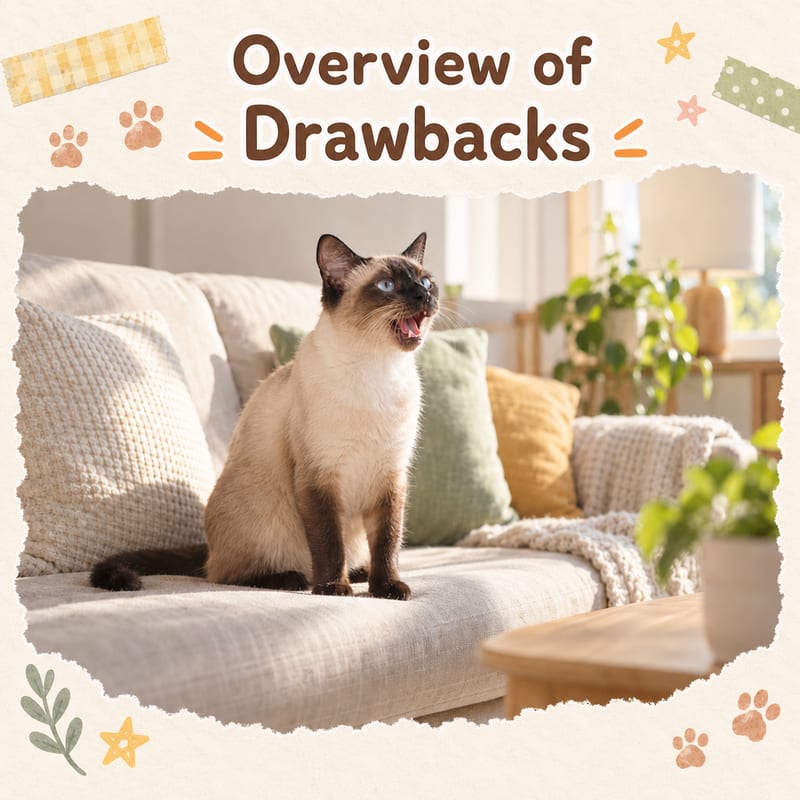
2. 'Crazy talker': meowing is a breed trait, not a bad habit
The Siamese voice is high-pitched, nasal, and so frequent it is jokingly called the 'public speaker of cats'—the CFA breed standard describes its temperament as extremely outgoing and loving lots of interaction with people. The essence of this disadvantage is desire to communicate: not only does it meow, it chooses when—hungry at dawn, bored at night, you in the toilet behind a closed door, all can become speaking occasions. Three coping points: first, do not train a 'meow = food' association by feeding on demand; fix feeding after a signal other than meowing; second, a high-intensity play session plus a small bedtime snack before sleep can significantly reduce the early-morning concert; third, increased meowing during the initial moving period and oestrus is normal—neutering addresses the latter. Complete silence is an impossible expectation, but a manageable level is 'occasional chatting' rather than 'whole-house echo'.
3. Clingy to the point of following you room to room: the other side of love is boundaries
Siamese generally follow owners from living room to kitchen to bedroom; when you sit, they jump on the table; when you open the laptop, they sit on the keyboard. This attachment is bliss for someone living alone, but a nuisance for those who need to take meetings or focus at home. Practical approach: set up 'their spot'—a window cat bed or a small perch beside the desk—and train a 'go to spot' command with treats (Siamese learn fast, so this has a high success rate); before important meetings, use a food puzzle toy and interactive play for 15–20 minutes to burn energy in exchange for a quiet window. What really needs watching is the other side: if clinginess manifests as being unable to leave you for a step, howling or inappropriate urination when you leave, that is already an anxiety signal, not affection.
4. Separation anxiety and boredom destruction: households alone eight hours must address this
This is the most underestimated Siamese disadvantage. In a home with no one around for long daytime hours, a bored Siamese will find its own entertainment: tearing tissues, opening cabinets, knocking things over, pulling curtains, even urinating inappropriately to express dissatisfaction. The general consensus in veterinary behaviour clinics is that stress-related over-grooming and appetite changes are often triggered by insufficient environmental stimulation; rule out illness first, then adjust the environment. Three layers of response: burn energy (a serious interactive session morning and evening, wand toys first), enrichment (vertical space, window viewing spots, food puzzle balls), companionship (if work hours cannot be adjusted, keeping two cats for company is the most accepted solution for Siamese). Do all three and the 'destruction' column can basically be crossed out.
5. Digestion and urinary: two medical budget areas for short-haired cats
General clinical observation and owner community experience both point to: Siamese have sensitive digestion; too-rapid food changes, food that is too cold, or spoiled wet food can cause loose stools; for the urinary tract, the common feline problem (weak drinking instinct) is more obvious in dry air-conditioned environments, and urinary blockage in male cats is an emergency measured in hours. The response is not complicated but must be done: transition food over 7–10 days, place water bowls away from food and litter, use a flowing fountain or change water three times a day, and take away wet food within half an hour of opening. Cost direction: these two are the main uses of the medical reserve (budget HK$300–500 per month), not an 'insurance-style' expense but 'this breed's normal policy'.
6. Genetic health tendencies: verification is more effective than worry
Literature and breed health guidelines mention tendencies to watch in Siamese: strabismus (vision usually unaffected, an appearance trait), AMY2-related familial neuropathy and other items breeders screen for, and heart issues in some lines. To be fair: these are categories where source verification can greatly reduce risk, not 'get a Siamese and hope for the best'. Check parent health records before buying or adopting (see the eight-item checklist in the price and adoption article), and add palpation and necessary indicators to annual health checks from middle age—more practical than any worry afterwards.
7. Who should not keep a Siamese: an honest list
Let's finish the ugly truth: if you match two of the following three, the Siamese disadvantage list will feel especially long—more than eight hours a day with no one home and no way to arrange company; sensitive to noise and living in an old building with poor soundproofing between walls; budget only covers basic food with no medical reserve. Conversely, if you want a cat that 'talks, chooses its owner, and waits at the door when you come home from work', the 'disadvantages' above are exactly what they offer. By the way, the more searched 'Ragdoll disadvantages': Ragdoll pain points centre on long-hair care and digestion, Siamese pain points centre on companionship and noise—one costs hands, the other costs heart; choosing is really choosing which cost you are willing to pay.
Key takeaways
- ✅ Siamese disadvantages centre on 'costing heart' not 'costing hands': companionship, noise, and boredom are the big three
- ✅ Meowing is a breed trait; manageable with routine and not rewarding accidentally, but cannot be eliminated
- ✅ Households with long hours alone: environmental enrichment + fixed interaction, or consider keeping two
- ✅ Sensitive digestion and urinary tendencies rely on care habits; budget HK$300–500 per month for medical reserve
- ✅ Genetic tendencies can be greatly reduced by source verification; check parent records before buying
- ✅ Ragdolls cost hands (long hair), Siamese cost heart (companionship); compare by your own cost type
Related reading
- Siamese cat price and adoption guide
- Siamese cat Hong Kong keeping guide: climate, regulations, and companionship needs
- Siamese cat personality and intelligence explained
- Siamese cat lifespan and health explained
- Food puzzle toys, cat trees, and flowing water fountains: PetChill pet supplies all in one place.
The health and behaviour content in this article is general information only; for individual diagnosis and treatment, consult a registered veterinarian or cat behaviour professional.
Further reading
- 7 things to know before keeping a Sphynx in Hong Kong →
- 7 real costs in Hong Kong to clarify first →
- 6 real costs every Hong Kong owner must read →
- 12 cat breeds personality and price comparison →
- Common diseases, preventive care, vet information →
- Cat vomit colour chart →
- Cat ear mite guide →
- Cat skin diseases complete guide →
- Cat kidney disease →
 Almo Nature full guide →
 Fuji One full guide →





