
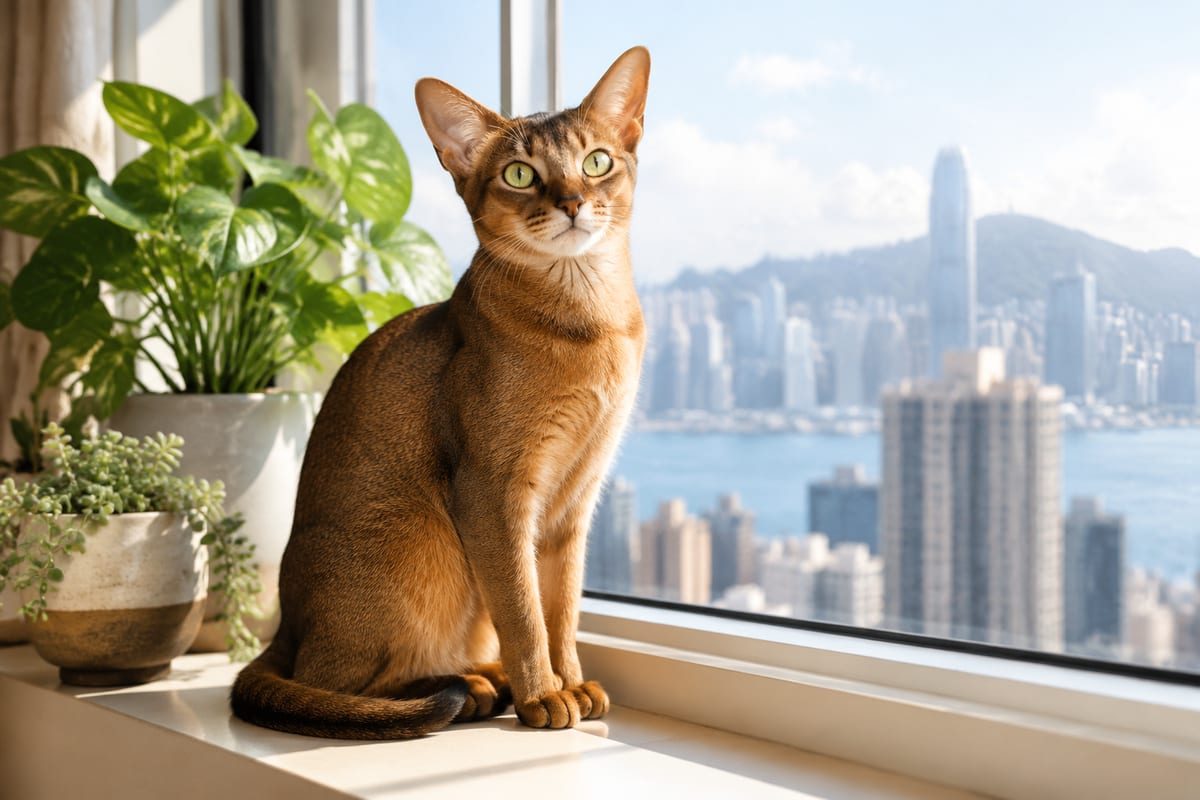
Quick answer: Abyssinian cats from Hong Kong catteries generally cost HK$10,000–18,000 (pet-grade), while pedigree-grade with complete parental PK gene and heart screening is HK$20,000–30,000. Purebred adoption is rare, but the SPCA and rescues occasionally have mixed short-haired ticked tabby types. Verification focus: parental PK enzyme deficiency screening records are a veto item for this breed; monthly expenses are about HK$900–1,500.
Want a comprehensive understanding of the Abyssinian cat? First see the Abyssinian Cat Breed Profile.
What kind of cat is the Abyssinian? 30-second summary
The Abyssinian is one of the oldest domestic cat breeds, characterised by its ticked tabby fine flecked coat, large ears and muscular build. Its personality is the 'athlete' of the cat world: climbing, patrolling, interacting—all expert, not a lap cat. The table below shows basic specifications; later we break down prices and costs item by item.
| Item | Abyssinian Cat |
|---|---|
| Origin | East Africa / Southeast Asia (disputed) |
| Average lifespan | 12–16 years |
| Weight | 3.5–5.5 kg (muscular medium cat) |
| Coat | Short ticked tabby, moderate shedding |
| Activity level | Extremely high (climbing type, needs vertical space) |
| Interaction needs | 45 minutes or more of play daily |
| Personality | Curious, active, affectionate but not clingy |
| Hong Kong price | About HK$10,000–30,000 |
| Monthly basic expenses | About HK$900–1,500 |
Three essential things to know:
- They are 'playmate cats' not 'sleeping companion cats' — those wanting a quiet lap cat should choose a British Shorthair.
- Vertical space is a must — a tall cat tree is not a luxury but a basic living standard for this breed.
- Escape prevention is a life-and-death issue — if you live in a high-rise without metal window screens, do not take this breed.
Abyssinian cat price and monthly expenses (2026 Hong Kong market)
| Item | Range | Remarks |
|---|---|---|
| Cattery pet-grade (with papers) | HK$10,000–18,000 | Pedigree certificate + first two vaccinations |
| Quality pedigree-grade | HK$20,000–30,000 | Parents' PK gene + heart screening complete |
| Adoption (mixed type) | HK$0–2,000 | Ticked tabby mixed type looks 90% similar |
| Vaccines (first year three doses) | HK$900–1,500 | Annual booster thereafter |
| Neutering | HK$1,500–3,500 | Male cheaper, female more expensive |
| Monthly food | HK$350–600 | Protein priority |
| Monthly cat litter | HK$150–250 | Active cats use more |
| Monthly toy consumption | HK$100–200 | Breed-specific item |
| Medical reserve (recommended) | HK$200–400 | For PK haemolysis and dental risks |
| Monthly total | About HK$900–1,500 | Excludes one-off escape prevention costs |
The easiest thing to miss for this breed is one-off expenses: a two-metre cat tree with installation HK$1,500–3,000, whole-house metal window screens HK$800–2,000. Taking a cat home without escape prevention means the money saved could become the cost of a lost cat.
Who is the Abyssinian cat suitable for?
| Owner type | Suitability | Reason |
|---|---|---|
| Likes interaction, daily play | Very suitable | 45 minutes of play is their basic switch |
| Work-from-home families | Suitable | They will patrol your desk, highly entertaining |
| Wants a quiet, lazy cat | Not recommended | Their default state is 'doing something' |
| High-rise residents without window screens | Not recommended | Climbing ability + curiosity = high risk of loss |
| Multi-cat households | Suitable | Highly social, cat companions help disperse energy |
Reverse self-test (three questions):
- Can you give 45 minutes of high-quality interaction daily (wand toys, chasing, puzzle toys)?
- Have you completed window screening and vertical routes at home? Is there a budget of HK$2,500–5,000?
- Can you accept midnight parkour and 'opening drawers' exploratory behaviour?
If you cannot answer 'yes' to two of the three, adopting an adult lazy cat would be a win-win option.
Abyssinian cat compared with other active breeds
| Breed | Activity level | Interaction needs | Monthly basic expenses | Suitable for beginners |
|---|---|---|---|---|
| Abyssinian | Extremely high | 45+ minutes daily | HK$900–1,500 | If time allows |
| Bengal | Extremely high | 60+ minutes daily | HK$1,000–1,800 | Experienced owners |
| Siamese | High | High (vocal) | HK$800–1,500 | If time allows |
| Oriental Shorthair | High | High | HK$800–1,400 | If time allows |
| British Shorthair | Low | Low-medium | HK$600–1,200 | Yes |
In one sentence: want a 'cat athlete' choose Abyssinian or Bengal; want interaction but not daily running, Siamese is the middle ground; want quiet go directly to the British Shorthair row.
Abyssinian cat health check schedule: when to test what
The three key issues for Abyssinians are PK haemolytic anaemia (hereditary), periodontal disease and kidneys. Regular checks are much cheaper than remedial treatment:
| Age | Recommended items | Approximate cost |
|---|---|---|
| 2–4 months | First-year three vaccinations + deworming | HK$900–1,500 |
| 6 months | Pre-neutering blood test + neutering | HK$2,000–4,000 |
| 1 year | Annual check-up + blood baseline | HK$600–1,000 |
| 2–7 years | Annual check-up + dental check | HK$800–1,500 |
| 8+ years | Every six months: blood, urine, kidney function | HK$1,200–2,000 per visit |
Three daily observation points (free but must be checked daily):
- Gums: redness, swelling, worsening breath, chewing on one side are periodontal signals.
- Water intake: sudden large increase combined with weight loss is a signal to test kidney function.
- Activity level: this breed not moving means illness—two consecutive days of not running or jumping warrants a vet appointment.
Three budget plans: thrifty, standard, secure
| Item | Thrifty | Standard | Secure |
|---|---|---|---|
| Food | HK$350/month | HK$480/month | HK$600/month |
| Cat litter | HK$150/month | HK$200/month | HK$250/month |
| Toys | HK$60/month (DIY substitutes) | HK$150/month | HK$200/month |
| Medical reserve | HK$100/month | HK$300/month | HK$500/month |
| Extras | — | Annual check-up | Six-monthly check-up + pet insurance |
| Monthly total | About HK$660 | About HK$1,130 | About HK$1,550 |
Insurance vs self-funded reserve: Hong Kong cat insurance annual premiums are generally HK$1,500–4,000. Abyssinian PK haemolysis is a hereditary disease, and many policies exclude hereditary diseases—read the terms clause by clause before buying, or simply set aside HK$300–500 monthly, which over ten years becomes a HK$36,000–60,000 medical fund.
Four most common Abyssinian cat misconceptions
| Misconception | Reality |
|---|---|
| Short-haired cats need no grooming | The fur needs no grooming, but they need 45 minutes of daily interaction—what needs grooming is time, not fur |
| Small cats have limited activity | A 5 kg Abyssinian's activity level equals a medium-sized dog; climbing and jumping are daily |
| Expensive means healthy | Expensive cats without PK screening can still be affected; price only makes sense with screening records |
| Adopting a mixed breed is a 'fake Abyssinian' | Ticked tabby mixed types can provide over 70% of the personality experience, and are already neutered and vaccinated |
After clearing misconceptions, let's get to the point: below we break down Hong Kong price ranges, adoption routes and the seven-step cattery verification.
One-page checklist before taking a cat home:
- Window screening and metal screens completed (about HK$800–2,000)
- Two-metre cat tree positioned (about HK$1,500–3,000)
- Book new cat vet check (within four weeks, about HK$600–1,000)
- Prepare two weeks' supply of old food; switch food using a seven-day gradual method
1. Hong Kong price ranges: what you pay for is records
| Tier | Price range | Usually includes | Suitable for |
|---|---|---|---|
| Adoption (mixed tabby type) | $0–$2,000 (medical cost sharing) | Already neutered, basic vaccinations | Those who cannot accept no papers but want this appearance and personality |
| Cattery pet-grade (with papers) | HK$10,000–18,000 | Pedigree certificate, first two vaccinations, basic check-up | Reasonable range for most families |
| Quality pedigree-grade | HK$20,000–30,000 | Parents' PK gene + heart screening records complete | Those seeking lowest risk with sufficient budget |
| 'Cheap paperless kittens' | Below $8,000 | ⚠️ No screening, questionable origin, possibly mixed breed passed off | Not recommended—money saved mostly goes back to the vet |
The breeding cost structure of this breed determines the floor price: small litter size, kittens need warmth and socialisation training, qualified breeders must do PK gene testing and annual heart screening. So a 'purebred Abyssinian' below cost price almost certainly lacks screening—and lack of PK screening is exactly the source of haemolytic anaemia cats.
2. Adoption routes: purebreds rare, mixed breeds available
Honestly, the chance of adopting a purebred Abyssinian: low. But two feasible directions: one, breed rescue—local cat breed rescue groups occasionally receive paperless Abyssinians (mostly surrendered cats), watch for their posts; two, ticked tabby mixed type—the SPCA and cattery rescues occasionally have short-haired tabby types with similar appearance (fine flecked coat), also active in personality. For those who want the 'high-jump champion and chatterbox' combination, adopting such a mixed breed can provide over 70% of the experience, and they are already neutered, vaccinated, and low cost. Before deciding to adopt, complete the self-assessment (see FAQ question 6): the surrender rate for this breed stems precisely from 'didn't expect them to be so active'. We do not recommend specific merchants or individual transactions; prioritise organisational adoption.
3. Cattery verification checklist: seven steps to avoid pitfalls
- On-site inspection: check breeding environment cleanliness, food storage, cats' mental state (healthy Abys are alert and curious, not withdrawn)
- See the parents: parents must be seen on site or via video; mother's constitution and personality are a reference for future kittens
- PK gene screening records: pyruvate kinase test reports for both parents—a veto item for this breed; eliminate if absent
- Pedigree registration: pedigree papers from proper registries such as CFA/TICA/FCI, not self-printed certificates
- Vaccinations and deworming: first two feline trivalent vaccinations and regular deworming completed before handover, with medical booklet
- Health guarantee and return clause: written guarantee for infectious diseases during incubation period, and 'return if unable to keep' arrangement
- After-sales support: breeders willing to give phone number and answer skin/kidney questions are the long-term ones
4. Monthly expense estimate: putting hidden costs on the table
| Item | Monthly estimate | Remarks |
|---|---|---|
| Staple food | HK$350–600 | Muscular breed, protein priority |
| Cat litter | HK$150–250 | Active cats need frequent scooping |
| Toy consumption | HK$100–200 | Abys play rough, rotation system |
| Medical reserve | HK$200–400 | Annual blood test plus dental amortised |
| Grooming | HK$0–100 | Short hair basically self-maintaining, occasional wipes |
| Total | About HK$900–1,500 | Excludes boarding and accident medical |
One-off costs: tall cat tree (two-metre) with bookshelf modification $1,500–3,000, whole-house metal window screens $800–2,000, carrier plus automatic feeder $500–1,000. Escape prevention is a hidden expense unique to this breed and must be included in the budget stage.
5. Contract and payment: terms to write down
Before payment, write clearly four things: scope and validity of health guarantee (infectious disease incubation period generally 14–30 days), neutering clause (pet-grade generally requires neutering within six to eight months), return arrangement (return if unable to keep or transfer requires breeder consent), and a copy of PK screening records as contract annex. Prioritise payment methods with transaction records. Two bottom lines: 'pay deposit first to see the cat'—refuse directly; 'all catteries are this price' sales talk—don't believe it—no screening should be cheaper, and cheap without screening is risk pricing.
6. 48 hours before and the first week after bringing the cat home
On the day of arrival, the environment must be ready: window screening completed, at least one vertical route open, food and water stations and litter tray positioned, warm corner for night. Use a hard double-lock carrier for the new cat—Abyssinian kittens start testing their lock-picking skills from day one. First week principle 'stability is king': follow the breeder's food and feeding schedule, no bathing (stress risk for kittens), no inviting friends to 'visit the new cat'. From the second week, establish long-term habits like tooth brushing and kitchen rules; complete the new cat vet check within four weeks (faecal test, basic blood panel, auscultation baseline); this report is your 'inspection certificate'—raise any issues within the guarantee period.
7. Ten-year total cost of ownership: calculating the 'keep for life' bill
The money for buying a cat is actually the entrance fee—the real budget test is the ten-year account. Using pet-grade $14,000 median entry and monthly median $1,200:
| Cost layer | Item | Ten-year estimate |
|---|---|---|
| One-off entry | Cat purchase | $10,000–18,000 |
| One-off entry | Cat tree, escape-proof screens, carrier, feeder | $2,800–6,000 |
| Juvenile (before 1 year) | Three vaccinations, neutering, new cat check | $4,300–7,300 |
| Annual fixed | Routine expenses ×10 (food, litter, toys, medical reserve) | $108,000–180,000 |
| Annual medical | Blood/urine tests from age 8 × about five years | $3,000–6,000 |
| Life incidents | One or two dental cleanings, emergency fund | $5,000–15,000 |
| Ten-year total | About $133,000–232,000 |
How to use this table: one, $900–1,500 monthly seems mild, but multiplied by ten years you realise it's a mortgage-level commitment; budget on a ten-year basis, not just the first half year; two, the adoption route ($0 entry) still has a ten-year total cost above $120,000—'adoption saves money' always refers only to the entrance fee; three, the biggest variable in the table is the 'life incidents' column: whether you have $10,000 emergency fund determines whether, when facing acute kidney injury or foreign body ingestion, you 'treat immediately' or 'ask the vet if instalments are possible'—this difference is the safety margin for a breed with hereditary risk lines. Finally, a note on value preservation: among all the above items, the ones you should least skimp on are escape-proof screens and recall training—these two directly determine whether the Abyssinian becomes a 'disappeared cat'; in Hong Kong high-rise lost cat cases, active breeds are noticeably overrepresented, and the loss from one escape can wipe out all the savings from ten years.
Related Reading
- Abyssinian Cat Disadvantages Full List
- Abyssinian Cat Lifespan and Health Full Analysis
- Abyssinian Cat Hong Kong Keeping Guide
- Abyssinian Cat Coat Colour Illustrated Guide
- Tall cat trees, flowing water fountains, metal window screen locks: get them all at PetChill Pet Supplies.
Prices in this article are general ranges for the 2026 Hong Kong market, for budget reference only; purchase and adoption decisions should be based on on-site verification and written contracts.
Further Reading
- Hong Kong 2026 →
- Bengal Cat Price and Adoption Guide: Hong Kong Cattery Market, Adoption Routes and Verification →
- Bichon Frise Hong Kong Price and Adoption Guide: 2026 Buy or Adopt Full Guide →
- 12 Cat Breeds Personality and Price Comparison →
- Common Diseases, Preventive Care, Vet Information →
- Cat Tail Language Full Interpretation →
- Cat Nail Trimming Hong Kong →
- Cat Weight Management Full Guide →
- Multi-Cat Household Complete Guide →
 Fuji One full guide →





