
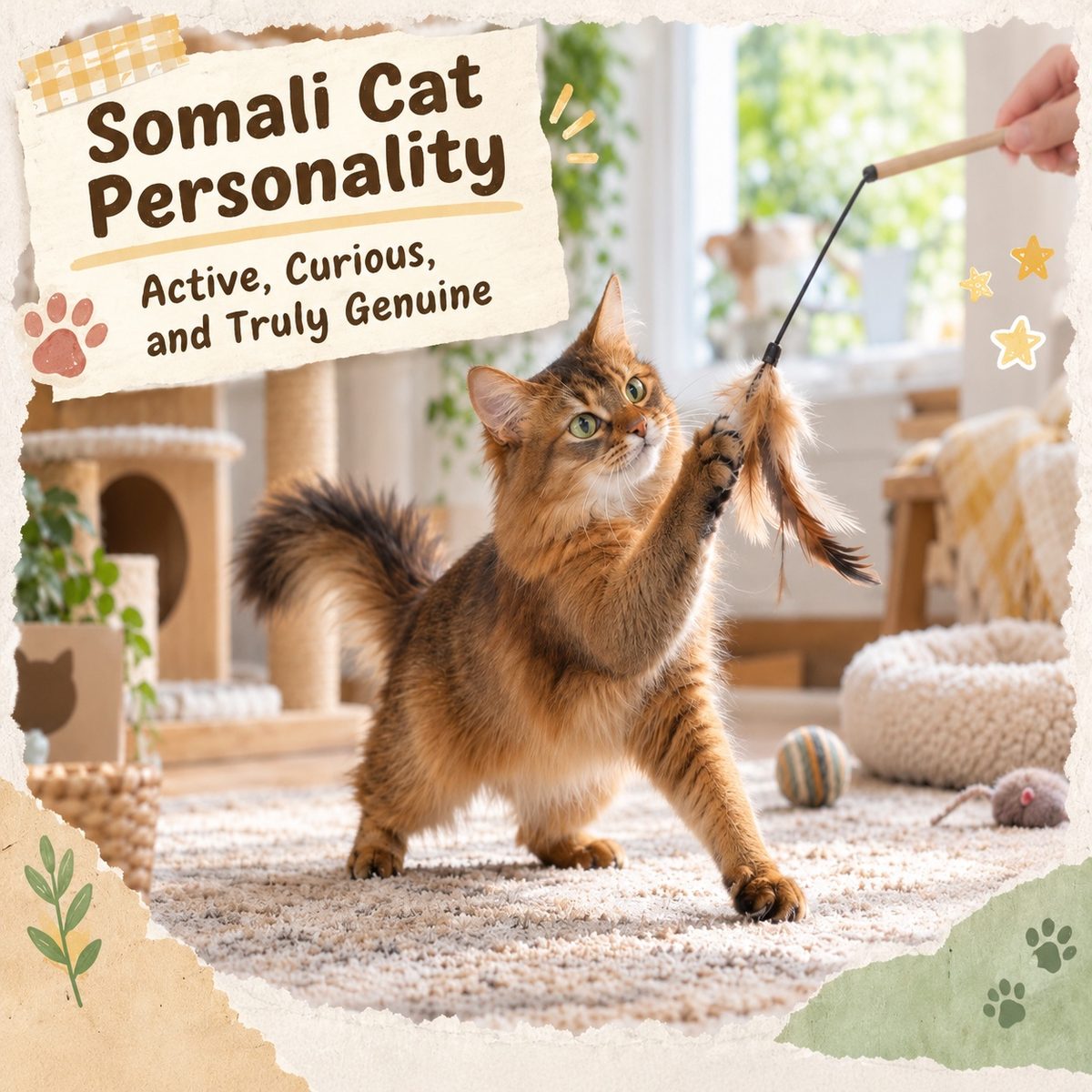
Quick answer: The Somali cat's personality in one sentence: 'a cat that wants you to do things with them.' They inherit the Abyssinian's active, smart, curious, confident and clingy foundation, plus the soft look of a semi-long coat and big tail. They are a high-interaction, high-activity companion type—not the static cat that lies next to you. Suitable for people with a fast-paced lifestyle who love to play and are willing to keep them company; if you want a static companion, think twice.
Want to know more about the Somali cat? Keep reading the series below.
1. Overview of five key personality traits
| Trait | Daily behaviour | Care implications |
|---|---|---|
| High activity | Patrols all high points from floor to ceiling | Two to three play sessions daily are essential |
| Smart and curious | Opens cabinets, unlocks, follows you around | Needs puzzle toys and new stimulation |
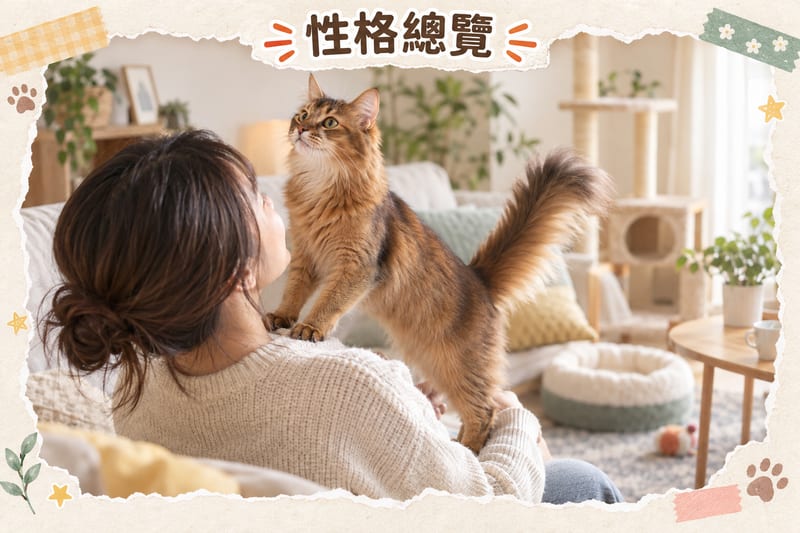
| Highly clingy | Follows you into the kitchen, sits on your lap | Alone time must be planned in advance |
| Confident and bold | Doesn't shrink from strangers, loves exploring | Early socialisation is ideal |
| Loves interaction | 'Talks' to you in a soft voice | High vocalisation frequency; light sleepers beware |
It's worth emphasising that these five traits are breed-wide, but each cat's 'intensity' varies: some Somalis are especially clingy, others more independent. Before adopting or buying, it's best to arrange a meeting to observe whether they approach you or hide in a corner—much more accurate than breed labels. Also, cats that are well socialised early will be much more accepting of strangers and new environments as adults.
2. Intelligence: a cat that can learn and fetch
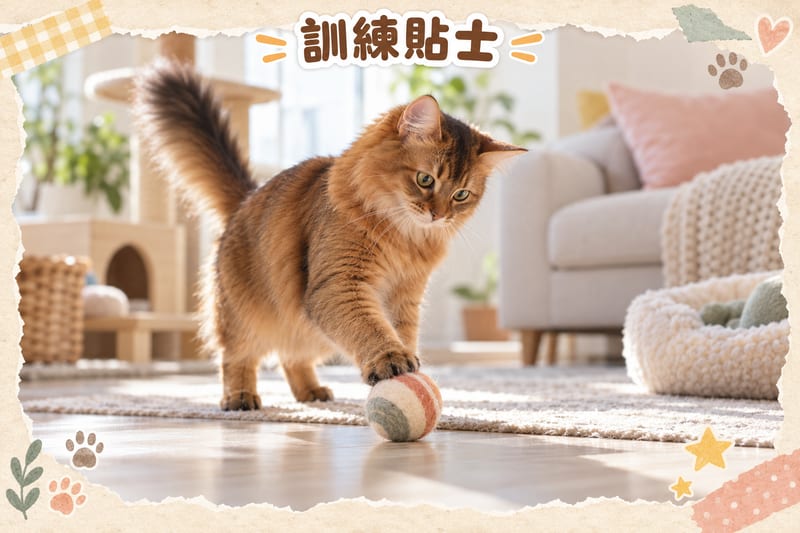
The Somali's intelligence is trainable intelligence. Real-world examples include: command training—generally can learn 'sit', 'high-five', 'fetch'; problem solving—many individuals fetch balls on their own, push open drawers, even learn to open cabinet doors. This ability is a double-edged sword—channel it well and they are the most engaged playmate; give them no entertainment and they'll create their own, which you usually won't like. The recommended approach is to prepare puzzle toys that can hold treats, rotate one or two daily, and use mental exercise to burn half their energy. For training, they respond well to clicker training; with treat rewards, they can learn basic commands in a few weeks. Short sessions of five to ten minutes daily are better than one half-hour session—their attention span is like ours and needs breaks. Some individuals even bring toys to you to ask for play, showing the breed's high engagement.
3. Getting along with children and other pets
Somali cats treat children as 'big playmates': willing to run and chase, don't hold grudges, don't scratch first, and are quite accepting of children. But two conditions must be kept: teach children not to hug too tightly (they need freedom to escape), and adults must be present during play (they jump fast and high, young children simply can't catch them). Regarding other pets, they have high social needs and are accepting of gentle dogs and other cats; in multi-cat households they usually lead the play. With dogs, because Somalis are bold and curious, they are generally not afraid of dogs, but the dog must be gentle and not chase cats; first meetings should be behind a barrier or on a leash, letting both sides get used to each other's scent slowly. In multi-pet households, it's best to provide separate food bowls, water bowls and resting spots for each cat to reduce resource competition.
4. Male-female differences: individual differences outweigh sex
| Aspect | Male cats generally tend to | Female cats generally tend to |
|---|---|---|
| Exploration | Bolder, no boundaries | More alert, with limits |
| Attachment | More actively seek attention | More sense of boundaries |
| Play | Rougher, play wildly | More refined, particular about play |
| Territory | More pronounced | More easy-going |
Emphasise: sex differences are far smaller than individual and lineage differences. Practical advice: don't decide based on 'wanting a male' or 'wanting a female', because the personality difference between a male and female from the same litter is often smaller than between two males from the same litter. Personality is an individual trait, not a sex trait. Before adopting or buying, meet them directly and choose the one that approaches you—more practical than choosing by sex label, because the chemistry between human and cat can't be predicted by sex.
5. Interaction tips and strategies for alone time
Interaction: two to three hunting games daily, each ten to fifteen minutes, is the baseline, along with puzzle toys and climbable vertical routes. Alone time: their tolerance for long periods alone is a breed weakness; more than eight hours without company can easily lead to mischief. The standard approach is to schedule daytime activities (timed feeders, window viewing spots, rotating puzzle toys) and full interaction before bed; for long-working families, the most practical answer is to get two, so they burn each other's energy. Also, Somali cats' enthusiasm for new toys usually lasts only a few days, so 'rotate' rather than 'buy more': only put out three or so at a time, store the rest, and swap every other week—low cost, high novelty. Also remember they love heights; vertical routes are the most effective tool for burning energy.
6. Comparison with Maine Coon personality
People searching 'Maine Coon personality' are often comparing several affectionate long-haired breeds. Maine Coons are gentle and steady, better at entertaining themselves, like a 'big dog type'; Somali cats are more active and energetic, more invested in people, needing more intensive companionship and play. Both are affectionate, but the Somali's energy and interaction needs are clearly a notch higher. In terms of price and care, Maine Coons are large, eat more and use more cat litter, so long-term costs are higher; Somalis are lighter and cheaper day-to-day. If you value interaction and play, the Somali's 'return on investment' will be higher; if you want a cat that can be alone more, the Maine Coon is more suitable. Whichever breed you choose, remember they are family, not decoration—the more companionship you invest, the more you get back.
7. Training tips
Somali cats learn fast, but only if rewards are immediate and sessions are short. Three key points: One, reward immediately with treats or toys—give within one second of completing the action so they connect it; Two, five to ten minutes per session is enough—too long and they lose interest; Three, use the same commands and be consistent across the family—avoid calling 'down' today and 'no' tomorrow. Do these three and many individuals can learn over ten actions, even willing to do simple performances with you—the best proof of a good human-cat relationship.
Key summary
- ✅ Somali cat personality = a cat that wants you to do things with them, a high-interaction companion type
- ✅ Intelligence above average among cats; can learn commands, fetch balls, learn to open locks
- ✅ Suitable for families with children, provided no tight hugging and adults present
- ✅ High social needs; in multi-cat households they usually lead the play
- ✅ Being alone is a weakness; long-working families should consider two cats or schedule daytime activities
- ✅ Compared with Maine Coons, Somalis are more active and need more companionship
- ✅ Rotate toys rather than buy more; training needs immediate rewards and short sessions
Related reading
- Somali cat disadvantages full list
- Somali cat Hong Kong care guide
- Somali cat coat colour guide
- Puzzle toys, teaser wands and tall cat trees: get them all at PetChill pet supplies.
The personality descriptions in this article are general observations; individual cats vary greatly. For behavioural or emotional abnormalities, please consult a registered veterinarian.
 Fuji One full guide →





