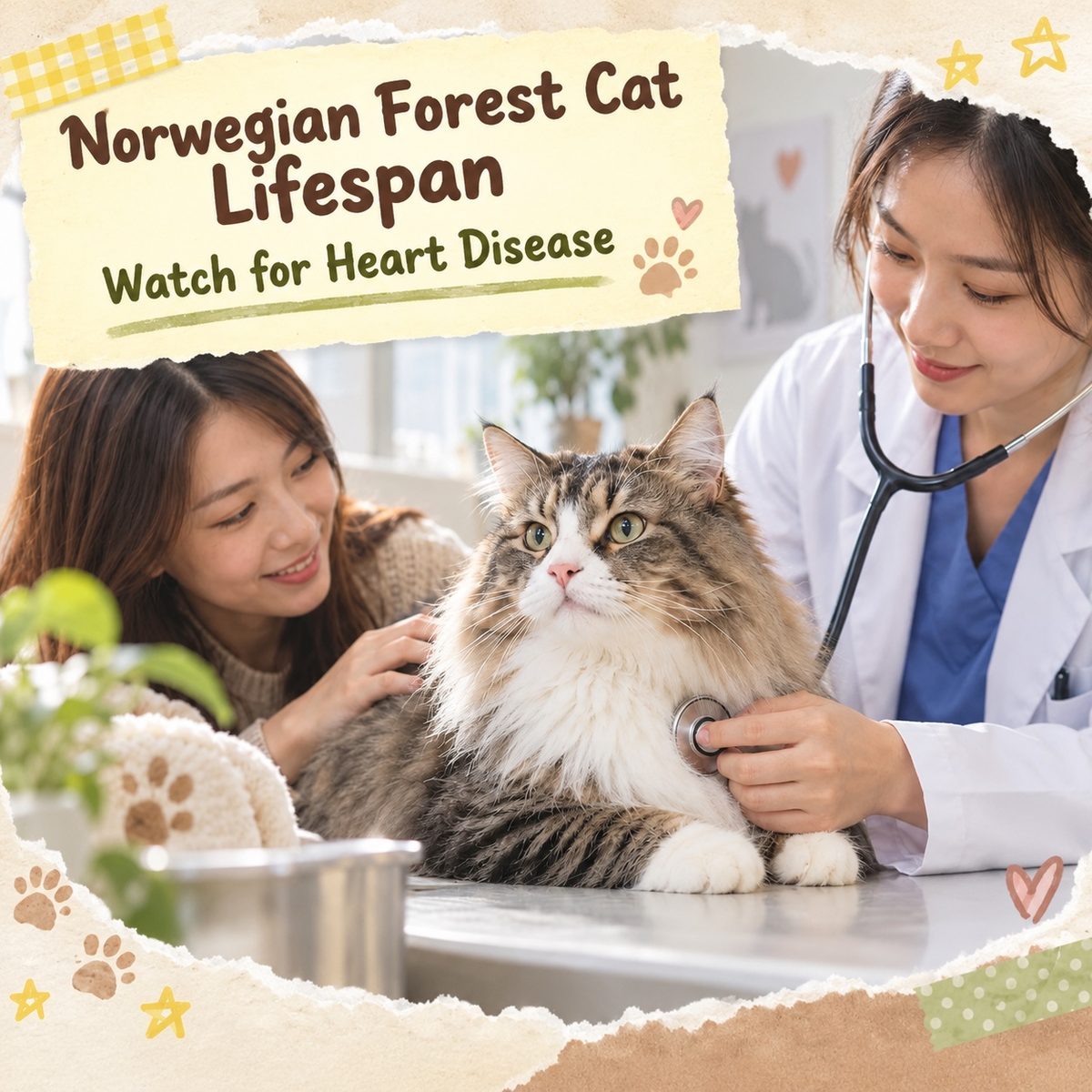
Quick answer: Norwegian Forest Cats are generally thought to live 12 to 16 years. The three concerns that most affect length of life are hypertrophic cardiomyopathy (HCM), glycogen storage disease (GSD IV) and hip dysplasia. Genes cannot be changed, but weight, a safe environment and checkup frequency are fully controllable.
Want to learn more about Norwegian Forest Cats? Keep reading the series below.
How long do Norwegian Forest Cats live?
In public sources, the quoted lifespan range for Norwegian Forest Cats is generally 12 to 16 years, which is above average among purebred cats. A UK purebred cat health survey gives a more conservative average, and some owners have recorded long-lived individuals over 18 years. Why such a wide range? Because the "breed average" is pulled by two things: the distribution of genetic disease lines, and quality of care. In other words, you cannot choose your genetic starting point, but you can absolutely choose the curve near the endpoint.
Veterinary resources from the Royal Veterinary College (RVC) in the UK and the University of California, Davis (UC Davis) in the US both point out that among breed-related diseases in cats, myocardial thickening and kidney disease are the two main causes pulling down average lifespan, while joint problems in large breeds also affect quality of life in later years. These are exactly the areas Norwegian Forest Cats need attention on.
It is worth noting that Norwegian Forest Cats are a slow-maturing breed and may not fully develop until 3 to 5 years old. This means their "growth period" is longer than that of ordinary domestic cats, and nutrition and weight management in the first few years have a particularly large impact on long-term health.
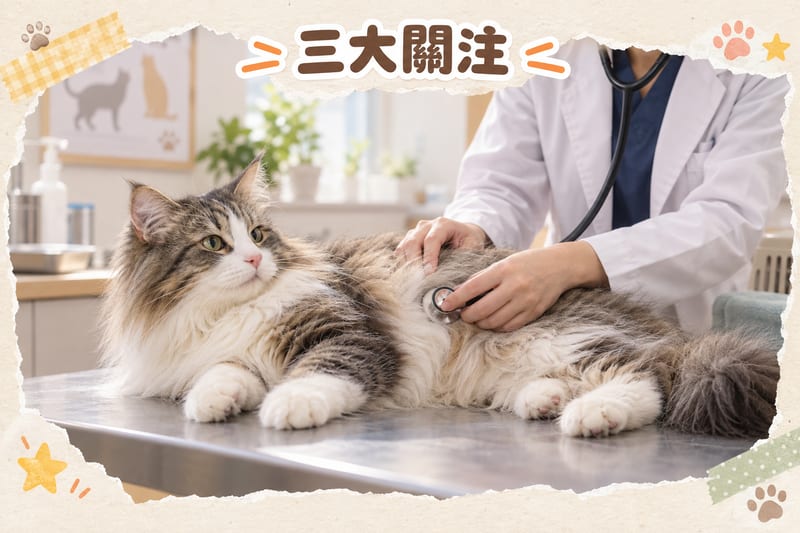
The three major health concerns affecting lifespan
1. Hypertrophic cardiomyopathy (HCM). Norwegian Forest Cats are one of the known susceptible breeds for hypertrophic cardiomyopathy (HCM), along with Maine Coons and Ragdolls. Some individuals carry MyBPC3 gene-related variants. HCM may only become apparent in adulthood, so "tested clear now" does not mean "clear forever". Response: ask the cattery for the parents' screening records, and after adulthood have regular cardiac ultrasound as advised by your veterinarian.
2. Glycogen storage disease type IV (GSD IV). This is a recessive genetic disease more specific to Norwegian Forest Cats, caused by a GBE1 gene mutation that affects the body's ability to process glycogen. Severely affected individuals show stunted growth as kittens and the condition can be quite serious. The good news: veterinary genetics laboratories such as UC Davis offer genetic testing, and testing parents before breeding is the responsible approach; carriers do not develop the disease but should not be bred to each other.
3. Hip dysplasia. A common orthopaedic problem in large cats; poor joint fit leads to pain when walking and reduced willingness to jump, and in the long term causes arthritis. Weight management is the most effective way to reduce strain — every kilogram lost noticeably reduces the load on the joints. X-ray assessment can be arranged if necessary.
In addition, polycystic kidney disease (PKD) and patellar luxation have also been seen in isolated cases in the breed, and are areas a veterinary checkup would also pay attention to.
Checkup focus table by age
| Stage | Age | Focus |
|---|---|---|
| Kitten | 0–1 year | Vaccination schedule, deworming, confirmation of GSD IV genetic background, weight curve tracking |
| Growth | 1–4 years | Weight management after neutering, first baseline blood and cardiac checkup |
| Adult | 4–8 years | Annual checkup, dental check, HCM screening at recommended intervals |
| Mature | 8–12 years | Checkup every six months, kidney values (SDMA/creatinine), blood pressure and thyroid |
| Senior | 12+ years | Checkup every six months to quarterly, joint pain management, mobility assessment |
Longevity checklist: the kind you stick on the fridge door
- Keep strictly indoors with window screens; zero free-roaming.
- Feed measured portions daily, weigh monthly, maintain ideal body condition score.
- Increase the proportion of wet food to protect urinary and kidney health.
- Keep parents' genetic screening records, and have cardiac ultrasound at intervals yourself.
- Do not skip vaccinations and deworming; indoor cats need them too.
- Check teeth every year — periodontal disease is linked to heart and kidney risk.
- From 8 years old, a checkup every six months with full blood tests.
- Stress management: provide space and reassurance during moving, renovation or a new family member.
- Emergency preparation: note the nearest 24-hour veterinarian and the response plan for poisoning or stroke.
- Insurance or a medical fund, so diagnosis is not delayed because of money.
Danger signs: the kind where you see a vet immediately
The following are red-flag symptoms requiring immediate medical attention, not a diagnostic list: rapid breathing or open-mouth breathing (possibly heart-related), sudden hind leg weakness (risk of blood clot), complete loss of appetite for more than 24 hours, persistent vomiting, frequent urination with no urine produced (urinary blockage is an emergency), suddenly unwilling to jump or crying out when landing (joint or bone pain). If any of these appear, do not wait for answers online — contact your veterinarian directly.
Norwegian Forest Cat vs Maine Coon: lifespan and health differences
Many Hong Kong readers searching for "Maine Coon lifespan" are also considering a Norwegian Forest Cat, because both are large long-haired cats. Health concerns overlap heavily: HCM and hip problems are shared risks, while GSD IV is more specific to the Norwegian Forest Cat. In terms of lifespan, both have quoted ranges of roughly 12 to 16 years, at the same level. In other words, which one you choose has far less impact on lifespan than how you care for it afterwards — weight, indoor safety and checkup frequency are the main battlegrounds.
Frequently asked questions
Q: How long do Norwegian Forest Cats live? A: Generally around 12 to 16 years, which is above average for cats. With indoor living, good weight management and regular checkups, many individuals can live past 16. Individual variation is large and depends on inherited disease lines and quality of care.
Q: What genetic diseases should I watch for in Norwegian Forest Cats? A: The three most concerning are hypertrophic cardiomyopathy (HCM), glycogen storage disease type IV (GSD IV) and hip dysplasia. HCM may only become apparent in adulthood; GSD IV has a genetic test; hip problems affect mobility. Ask the breeder for the parents' screening records.
Q: What is GSD IV, and is it very serious? A: GSD IV is a recessive genetic disease specific to Norwegian Forest Cats, caused by a GBE1 gene mutation that affects glycogen metabolism. Severely affected individuals show stunted growth as kittens and the condition can be very serious. Laboratories such as UC Davis offer genetic testing; testing parents first is the responsible approach.
Q: At what age is a Norwegian Forest Cat considered senior? A: Norwegian Forest Cats mature slowly and may not fully develop until 3 to 5 years old; they generally enter maturity at 8 to 10 years, and are considered senior from 12 years. After maturity, a health check every six months is recommended, focusing on the heart, kidneys and joints.
Q: Does indoor living really extend lifespan? A: Yes. Multiple cat life statistics show that indoor cats live significantly longer on average than free-roaming cats, with car accidents, infections and poisoning being the main sources of the difference. Norwegian Forest Cats are active and love heights, so keeping them strictly indoors with window screens is the most basic life-saving measure.
Q: What are the three most important things on the longevity checklist? A: First, keep strictly indoors with window screens; second, feed measured portions to maintain ideal weight and reduce strain on the heart and joints; third, schedule regular veterinary checkups according to age and keep genetic screening records.
Key points
- ✅ Norwegian Forest Cat lifespan is generally thought to be 12 to 16 years, above average for purebred cats.
- ✅ Three major health concerns: HCM, GSD IV (glycogen storage disease), hip dysplasia.
- ✅ GSD IV has a genetic test; testing parents first is a must-check before buying a cat.
- ✅ A slow-maturing breed, fully developed at 3 to 5 years; weight management in the early years has far-reaching effects.
- ✅ Strictly indoor living with window screens is the simplest and most effective lifespan extension measure.
- ✅ Rapid breathing, hind leg weakness and no urine output are emergency red flags — take to the vet immediately.
Related reading
- Norwegian Forest Cat care in Hong Kong
- Norwegian Forest Cat price and adoption guide
- Norwegian Forest Cat pros and cons explained
- Norwegian Forest Cat growth and weight tracking
- For weight and health management support: see PetChill pet supplies for measuring bowls, pet scales and circulating water fountains.
The health information in this article is for general reference only and does not constitute diagnosis or treatment advice; consult a registered veterinarian for individual medical arrangements for your Norwegian Forest Cat.
 Royal Canin full guide →