
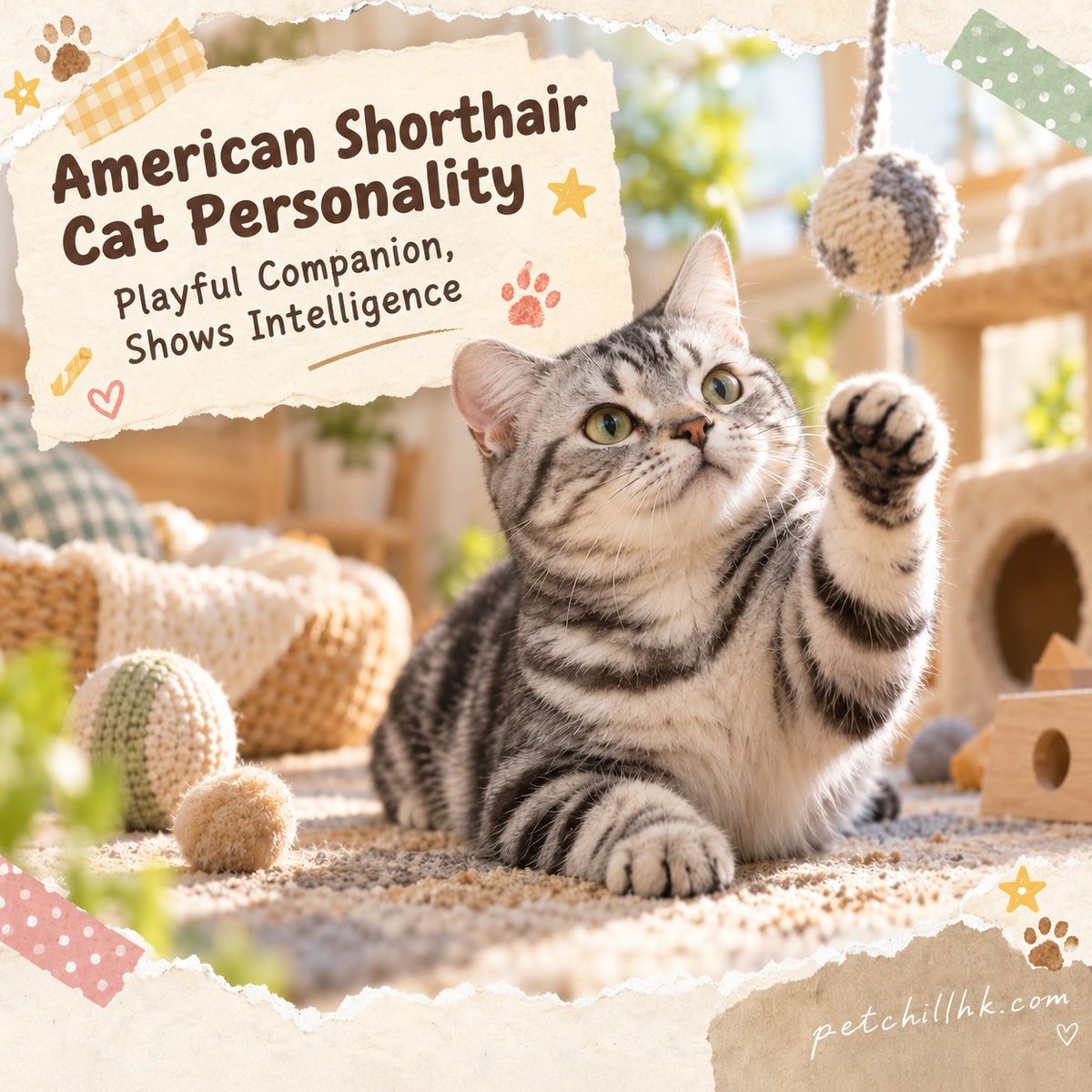
Quick answer: Three keywords for the American Shorthair personality: friendly, confident, needs to burn energy. They are companion-type cats — smart, problem-solving, highly compatible with children, but they need daily interactive sessions; left idle, they will find their own entertainment. Compared with the British Shorthair's "calm panda" script, the American Shorthair's personality cost is concentrated in time, not money.
Want a full introduction to the American Shorthair? Start with the American Shorthair breed profile.
What kind of cat is the American Shorthair? 30-second summary
The American Shorthair is a descendant of North American farm cats, with a sturdy build and stable temperament — in the first tier of "easiest to live with" pure breeds. Its personality script is companion-type: smart, proactive, needs activities. The table below covers the specs Hong Kong owners look up most; personality and costs are broken down further below.
| Item | American Shorthair |
|---|---|
| Origin | United States (descended from European settlers' working cats) |
| Average lifespan | 15–17 years |
| Weight | Male 5–7 kg / Female 4–5.5 kg |
| Coat | Short, dense; moderate shedding in moulting season |
| Personality keywords | Friendly, confident, needs to burn energy |
| Vocalisation | Low to moderate; not a chatterbox type |
| Tolerance of being alone | Medium (better than Siamese, but cannot be left alone for 10-plus hours every day) |
| Intelligence / trainability | High (strong operant learning; food rewards work best) |
| Hong Kong price | About HK$8,000–18,000 |
| Monthly basic expenses | About HK$600–1,200 |
Three fundamentals you must know:
- "Needs to burn energy" is a need, not a personality flaw — two interactive play sessions a day are the baseline; skip them and the cat will make its own entertainment.
- Intelligence is pragmatic — learns fast, but only what benefits it; training relies on treats, not applause.
- A good temper is built — socialisation experiences between two and seven months of age determine the upper limit of adult tolerance.
American Shorthair price and monthly costs (2026 Hong Kong market)
Buying the cat is the entry fee; monthly costs are the long-term commitment. The table below shows actual Hong Kong market ranges; ask about each item clearly before ordering:
| Item | Range | Notes |
|---|---|---|
| Registered cattery | HK$10,000–18,000 | With pedigree certificate, parents' health records |
| Licensed pet shop | HK$8,000–14,000 | Symmetry of coat pattern affects price |
| Adoption | HK$0–2,000 | Mostly already neutered and vaccinated |
| Vaccines (first-year three doses) | HK$900–1,500 | Annual booster thereafter |
| Neutering | HK$1,500–3,500 | Cheaper for males, more for females |
| Monthly food | HK$350–700 | Dry and wet mixed; more active cats eat more |
| Monthly cat litter | HK$120–250 | Clumping clay / tofu litter |
| Monthly deworming (share) | HK$80–150 | Internal and external |
| Energy-burning toys (share) | HK$50–150 | Wand toys, puzzle feeders are consumables |
| Medical reserve (recommended) | HK$200–400 | Sturdy constitution, but accidents and teeth still need budgeting |
| Monthly total | About HK$600–1,200 | Excluding major medical costs |
The American Shorthair's personality cost is time more than money: two sessions a day of 10–15 minutes interactive play adds up to over 180 hours a year. Before buying, ask your schedule, not your wallet.
Who is the American Shorthair suitable for?
| Owner type | Suitability | Reason |
|---|---|---|
| Families with children | Very suitable | Good pain tolerance, loves chase games, not quick to use claws |
| Nine-to-six dual-income household | Suitable | Medium tolerance of daytime solitude; make up interaction after work |
| Work-from-home person | Suitable | Interaction needs can be met immediately |
| Nine-to-nine single person | Not recommended | Left alone too long; energy with no outlet leads to destruction |
| People wanting "quiet companionship" | Not recommended | American Shorthairs need activities; they are not background-music cats |
Reverse self-check (three questions):
- Can you reliably give 20–30 minutes of focused play every day?
- Is there a cupboard or door in your home that it can open and you cannot accept?
- If you travel for two or three days at the weekend, does someone help burn the cat's energy?
If you cannot answer "yes" to two of the three, the American Shorthair's "smartness" will be used where you do not want it — opening cupboards, tearing paper, midnight parkour are all signals of energy with no outlet.
American Shorthair compared with other breeds
| Breed | Energy level | Clinginess | Trainability | Monthly basic expenses | Suitable for beginners |
|---|---|---|---|---|---|
| American Shorthair | High | Medium | High | HK$600–1,200 | If you have time |
| British Shorthair | Low | Medium | Medium | HK$600–1,100 | Yes |
| Siamese | High | Very high | High | HK$800–1,500 | If you can keep up |
| Ragdoll | Low | High | Medium | HK$900–1,600 | Yes (long hair) |
| Bengal | Very high | Medium | High | HK$800–1,500 | Not for beginners |
In one sentence: want interaction without being clung to — the American Shorthair is the balance point; want completely static companionship — choose the British Shorthair; want extremely high interaction and have experience — then consider the Bengal.
A daily energy-burning schedule for the American Shorthair
"Needs to burn energy" is easy to say; in practice it is a scheduling question. Below is a feasible version for Hong Kong working households, about 30–40 minutes of interaction a day in three segments:
| Time | Activity | Purpose |
|---|---|---|
| 10 minutes before leaving in the morning | Wand-toy chase + finish with breakfast | Burn energy, sleep well during the day |
| 15 minutes after getting home | Hunting-sequence play (chase → pounce → bite toy) | Make up the day's interaction quota |
| 10 minutes before bed | Slow wand play + bedtime snack | Burn the last energy, reduce midnight parkour |
| During daytime solitude | Puzzle feeder, cardboard boxes, window perch | Let it entertain itself without you present |
Three execution details:
- Play must "close" — give food after play so the hunting sequence is complete and the cat is truly satisfied.
- Rotate toys — the same wand toy for two weeks straight loses interest; rotate to keep them valuable.
- Laser pointers only as an opener — a light spot that can never be caught builds frustration; always switch to a physical toy it can catch at the end.
- Quality of interaction beats duration — 15 minutes of fully engaged chase is better than an hour of waving a wand while looking at your phone.
- Signs of insufficient energy burning are easy to spot — midnight parkour, random ankle pouncing, chewing cables are all complaint letters saying "not enough activities today".
Four most common American Shorthair misconceptions
| Misconception | Reality |
|---|---|
| American Shorthairs are short-haired so no brushing needed | Dense coat; heavy shedding in moulting season; brushing once or twice a week is still needed |
| American Shorthairs are so good-natured, no socialisation training needed | The good-temperament reputation is built on positive experiences at 2–7 months; missing the window can still cause problems |
| American Shorthairs are so clever, they can be trained like dogs | Strong operant learning but low obedience; practical behaviours (carrier, nail clipping) can be taught, but tricks are half the result for double the effort |
| With-white American Shorthairs are especially affectionate / especially naughty | Coat-colour genes have no stable link to personality; such claims are anecdotal; observe each cat's behaviour for accuracy |
American Shorthair and home space: how to set up a small flat
Keeping an American Shorthair in a 400 sq ft Hong Kong flat is absolutely feasible; the key is not floor area but vertical space and route design. The American Shorthair is a hunting cat; what it needs is not a big hall but an environment with "things to watch, things to chase, high places":
| Setup | Approximate cost | Function |
|---|---|---|
| Cat tree / climbing tower (one or two) | HK$300–1,500 | Vertical territory, for energy burning and viewing |
| Window perch | HK$0–200 | "Cat TV", passes time during the day |
| Wall shelf route | HK$200–800 | Three-dimensional route through the home; a lifesaver in small flats |
| Cardboard boxes and tunnels (rotated regularly) | HK$0–100 | Hiding and ambush spots, satisfies the hunting script |
| Store dangerous items | HK$0 | American Shorthairs can open cupboards; medicines and small items need physical locks |
One practical standard: can it "find its own entertainment" during the day? In a well-set-up flat, it will rotate between window perch, cat tree and tunnel; in a poorly set-up one, it will use your sofa and curtains as entertainment — the only difference is whether you spent a few hundred dollars beforehand or a few thousand afterwards.
One more note: cat trees need not be expensive; stability is the point. A wobbly cat tree will be used once and never again; check base weight and load ratings before buying — saving a hundred or so dollars is usually a false economy.
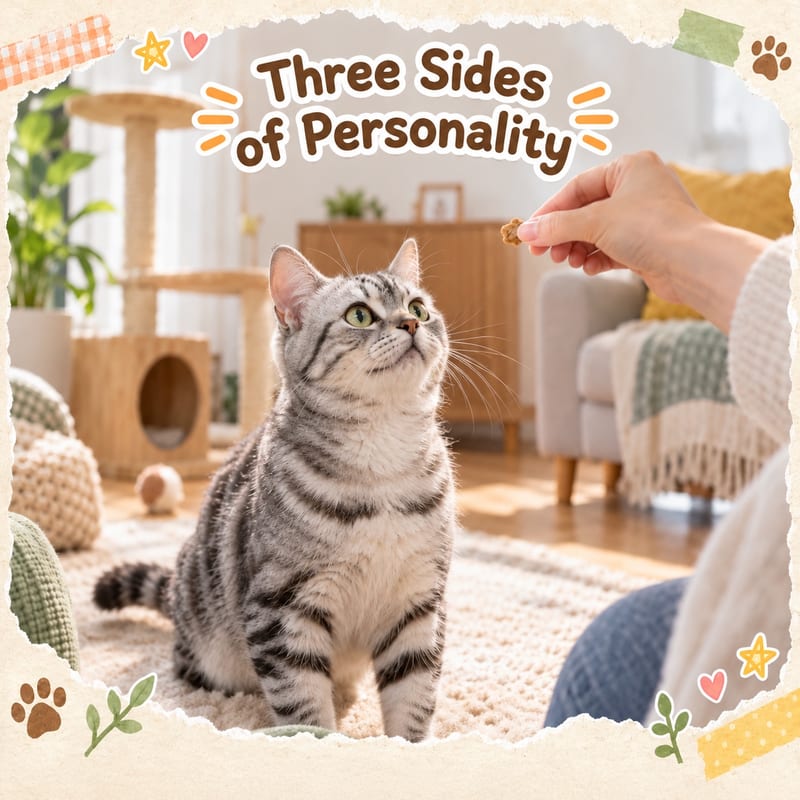
Three dimensions of the American Shorthair personality
The CFA breed standard describes the American Shorthair as a sturdy, well-proportioned working cat, with a temperament requirement of "sweet and easy-going" — this North American farm-cat background is written directly into the personality:
- Friendly but not subservient: close to family, welcomes friends, but does not stick to everyone; has wariness but recovers quickly, not a grudge-holder.
- Confident: high willingness to explore new environments; generally quick to habituate to household sounds like vacuum cleaners — this sets it apart from neurotic breed types.
- High energy: prey drive and stamina are in the first tier of pure breeds; "moving around when idle" is a need, not an option for the American Shorthair.
American Shorthair intelligence: pragmatic smarts
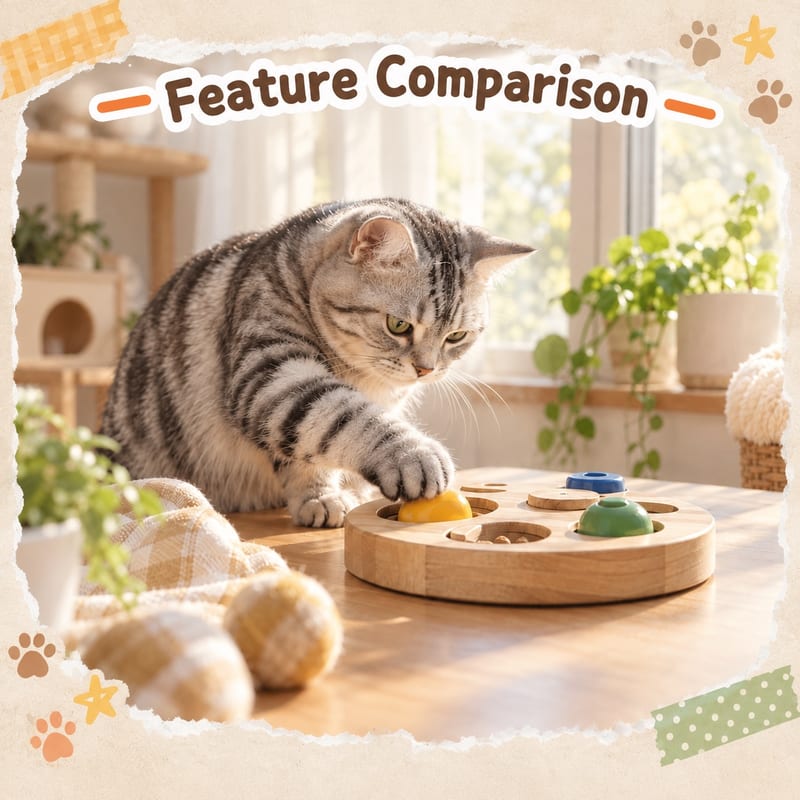
So-called "cat intelligence rankings" are mostly enthusiasts' ordering of obedience, not rigorous measurement; animal behaviour research breaks cat cognition into problem-solving, social cue reading, observational learning and environmental memory. The American Shorthair has a particularly good reputation in problem-solving and operant learning: can push doors, open cupboards, and use "walk to the food bowl and sit" to operate its owner into serving food. Their intelligence is very practical — they will not learn for applause, but will learn everything for treats and play. Cue training can use food rewards; setting goals as practical behaviours (carrier, car, nail clipping) has a much higher success rate than performance tricks.
Trait × behaviour × owner response table
| Trait | Daily behaviour | Suggested response |
|---|---|---|
| High prey drive | Pouncing on flies, chasing light spots, rough play | Two wand-toy sessions daily: "burn energy + finish with food" |
| Strong operant learning | Can open doors, cupboards, press buttons | Use physical locks where you want to stop it; don't rely on scolding |
| Confident, low anxiety | Calm response to new environments | Still build positive experiences during the socialisation window |
| Affectionate but independent | Knows how to accompany, not cling | Puzzle toys fill in when the owner is busy |
| Moderate wariness | Observes strangers before approaching | Let it set the pace of approach |
With children and other pets: how well they match
What searchers of "British Shorthair personality" and "American Shorthair personality" care about most is family suitability. American Shorthairs generally match well with children: good pain tolerance, not quick to use claws, enjoy chase games — but remember the bottom line: children under six and any cat must never be alone without an adult present; teach children "stroke the back, not the belly; no tail-pulling, no riding the cat"; give the cat a high escape route children cannot reach. With other cats, the American Shorthair has good social flexibility; gradual introductions generally succeed. With dogs in the same home, choose low-prey-drive dogs, first meetings through a barrier; peace is usually established within one or two weeks. A reverse issue to watch: small fish tanks, hamsters and birds are entertainment, not friends, in the American Shorthair's eyes — physical separation is needed.
Male-female differences and the "American Shorthair with white personality" myth
After neutering, male-female personality differences in American Shorthairs are small; it is generally thought males are a little more playful and relaxed, females a little more independent and refined, but individual differences far exceed sex differences. As for claims that "with-white American Shorthairs have a special personality" — coat-colour genes have no stable link to personality; white markings do not change prey drive or social style; such claims are sellers' anecdotes with no genetic support. Choose a cat by observing each individual's behaviour, not by buying a personality from coat colour.
British Shorthair, American Shorthair, Exotic Shorthair: three round-faced scripts
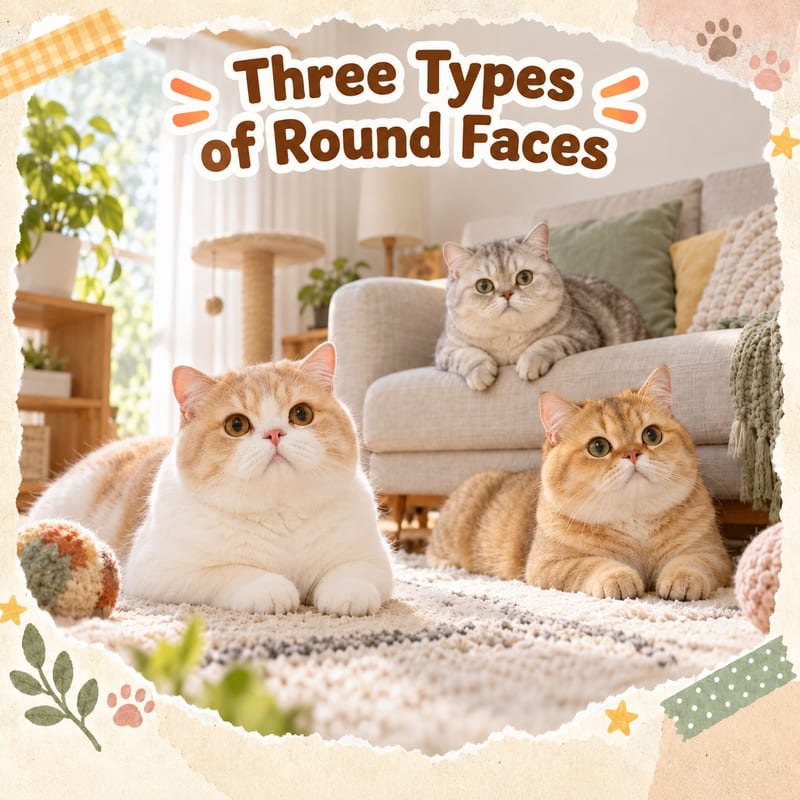
People searching "British Shorthair intelligence" often cannot decide among the three. An honest comparison: none of the three is a "performance-type smart"; there is no evidence of cognitive differences; the real difference is energy and companionship style — the British Shorthair is calm and independent, happily sleeping 20-plus hours a day; the Exotic Shorthair is quiet and attached, the most time-efficient cuddle; the American Shorthair is high-energy and interactive, needing activities but giving the highest interactive return as a companion. Choosing among them is really asking yourself: how much time do I have for a cat each day.
Temperament reputation: how to raise a cat that doesn't bite
The American Shorthair is not an irritable type. In clinical behaviour cases, defensive biting and scratching usually stem from three things: lack of positive experiences during the socialisation window (2–7 months), chronic pain (undiagnosed joint or oral problems), or being trained by incorrect play to see hands as prey. Prevention is straightforward: during kittenhood, play with hands and tools, never tease with hands or feet; if an adult cat's temper suddenly worsens, book a veterinarian to rule out pain first, then consider behavioural factors.
Socialisation window: the golden homework from 2–7 months
The American Shorthair's "good temperament reputation" is not delivered automatically; window-period experiences are the foundation. For cats entering a new home at 2–7 months, build the foundation at this pace: positive contact — short daily sessions letting hands touch paws, ears, open the mouth, with treats afterwards, desensitising all the "handling spots" needed for future grooming and vet visits; sound desensitisation — vacuum cleaner, hairdryer on low, played outside the door, during meals, one minute at a time; environmental exploration — open one more room each day; do not give free run of the whole home at first (dangerous items not yet stored); same-species socialisation — if possible, let it meet a stable adult cat through a barrier once, to learn "cat etiquette". Do this homework well and the American Shorthair's confidence and low-anxiety tendencies are amplified; missing the window is not the end of the world, but everything must be done more slowly and with more rewards.
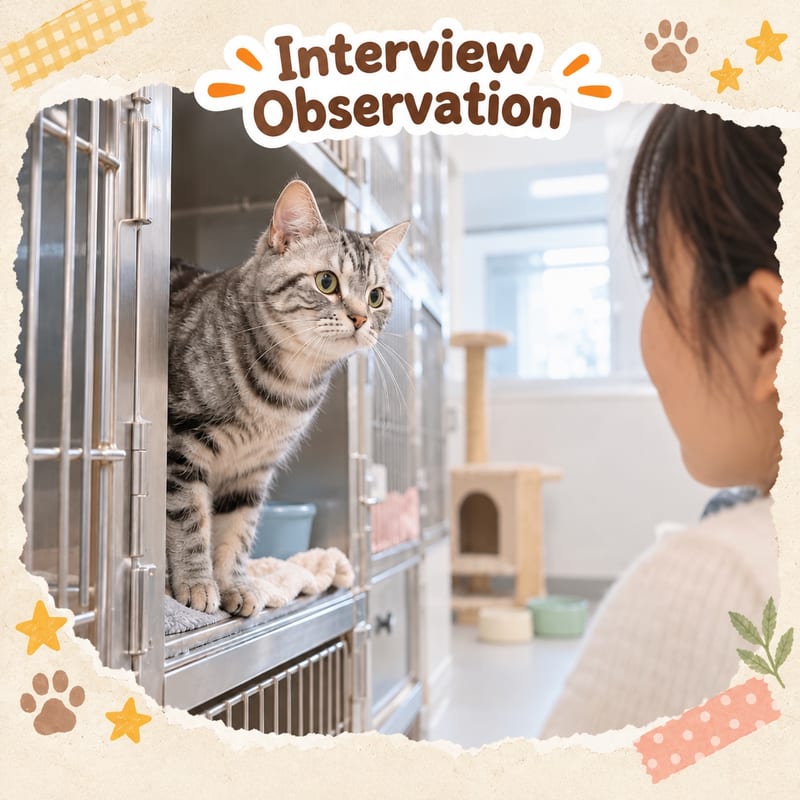
Five observation points at an adoption interview
On the day you meet the adoption organisation, use five details to quickly verify the personality script: one, play invitation test — drag a wand toy in front of it; the ideal response is a complete sequence of staring, butt-wiggling, pouncing; complete lack of interest warrants asking about health history; two, sound test — gently shake a treat jar; whether it looks and approaches reflects exploratory motivation; three, touch acceptance — stroke from neck to back, watch for impatient tail flicking; four, stranger desensitisation — have a friend it has never met sit down, see how long before it approaches voluntarily (American Shorthairs should generally make tentative moves within 3–10 minutes); five, interaction with cats in the same room — if displayed with other cats, observe whether it competes for resources. Pass all five and it is basically the "friendly, confident, needs to burn energy" script described in this article.
Key takeaways
- ✅ Three keywords for the American Shorthair personality: friendly, confident, needs to burn energy; a typical companion type, not a cuddle-pillow type.
- ✅ Intelligence strengths lie in problem-solving and operant learning; train practical behaviours with food rewards.
- ✅ High compatibility with children, but adult supervision and correct play cannot be skipped.
- ✅ Coat patterns such as with-white have no stable link to personality; choose a cat by individual behaviour.
- ✅ If temperament worsens, the first step is a vet visit to rule out pain; do not jump to conclusions.
Related reading
- American Shorthair disadvantages and how to cope
- American Shorthair weight and growth guide
- American Shorthair colours explained
- Wand toys, puzzle feeders and cat beds: see the energy-burning toy range at PetChill pet supplies.
Behaviour descriptions in this article are general breed tendencies; individual cat behaviour is affected by socialisation, health and experience; for aggression or anxiety issues, consult a registered veterinarian or accredited behaviour consultant.
 Fuji One full guide →





