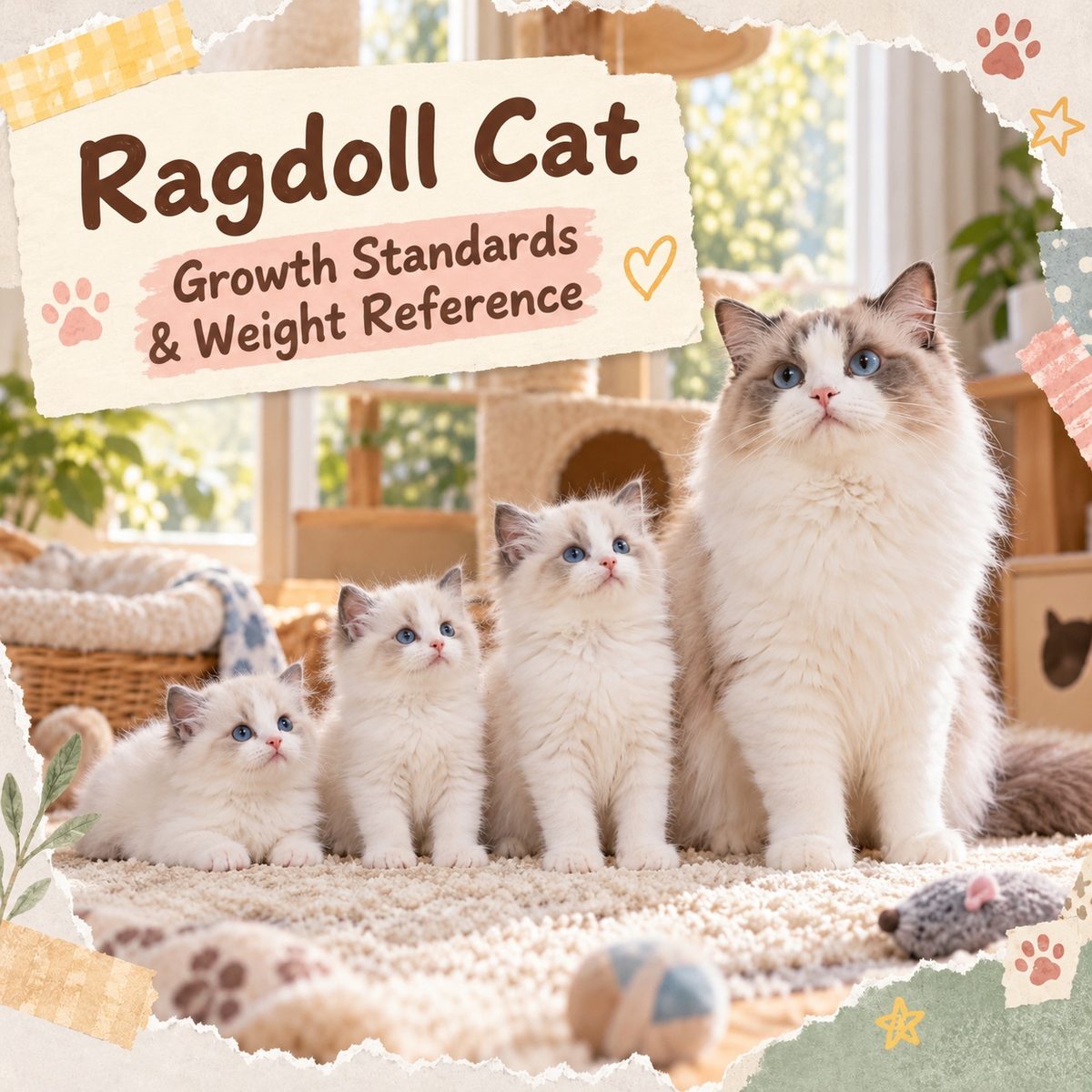
Quick answer: Ragdoll weight standards: adult males generally 6–9.5 kg, females 4.5–7 kg. They are a large breed and fully mature only at 3–4 years old. The 'Ragdoll weight chart' is only a reference framework; what really matters is the growth curve you measure consistently every month, and the body condition score (BCS) where you can feel the ribs. A single day's weight means nothing—whether overweight or underweight, adjust feeding and activity early.
Want to know all about Ragdolls? First see the Ragdoll breed profile and the complete Ragdoll guide.
Why Ragdolls need a separate weight chart
Because Ragdolls are not simply 'bigger versions of ordinary cats'. Three breed-specific traits mean that applying ordinary cat growth experience directly will lead to mistakes:
- Slow maturing: Most cats are fully grown by 1 year, but Ragdolls take 3–4 years. Judging a two-year-old Ragdoll as 'still lean and long' using short-haired cat standards is a misjudgement.
- High endpoint: Adult males can approach or even exceed 9 kg, making them one of the largest domestic cat breeds. Cat trees, litter boxes, and carrier sizes all need to be sized accordingly.
- Muscular build: Ragdolls have a high proportion of muscle and water in their weight. A Ragdoll and an ordinary cat at the same number can have completely different body conditions—which is why the weight chart and body condition score must go hand in hand.
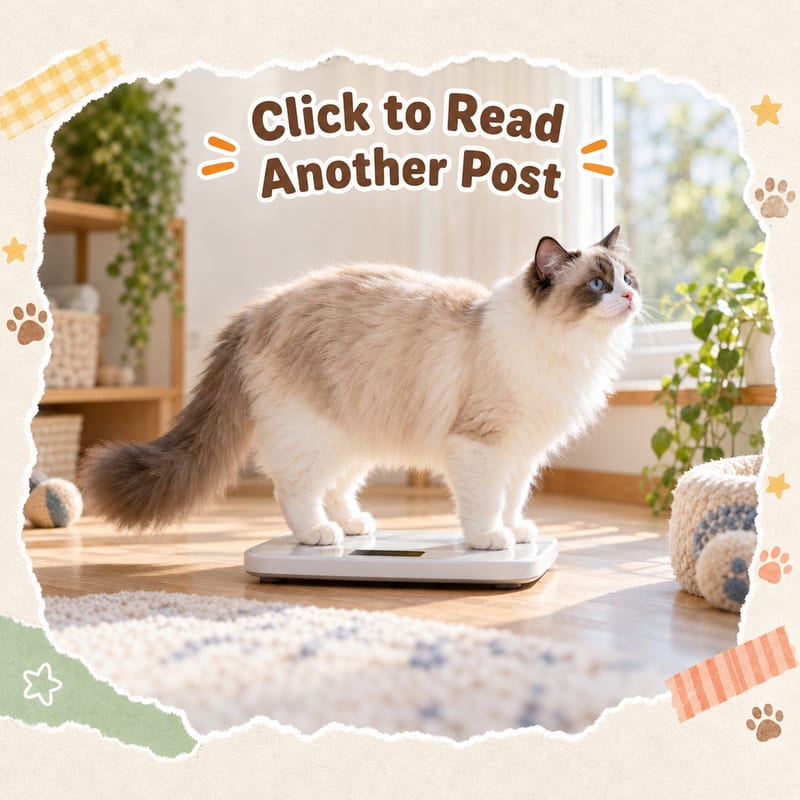
Growth weight reference chart from 0–4 years
The following are reference ranges compiled from breed data and general veterinary clinic observations (individual variation is large; the trend of the curve is more important than a single point):
| Age (months) | Weight reference (kg) | Stage focus |
|---|---|---|
| 2 months | 0.8–1.4 | Just arrived home; stabilise appetite and bowel movements first |
| 3 months | 1.2–2.0 | Vaccination period; weigh every two weeks |
| 4 months | 1.6–2.8 | Teething period; watch biting and eating speed |
| 6 months | 2.5–4.0 | Approaching neutering window; switch to measured feeding |
| 9 months | 3.2–5.0 | Rapid height growth, long legs and body; 'lean and long' is normal |
| 12 months | 4.0–6.0 | First-year health check; establish baseline data |
| 18 months | 4.5–7.0 | Growth rate slows; control calories |
| 24 months | 5.0–8.0 | Body starts to 'fill out'; chest and neck thicken |
| 36–48 months | 4.5–9.5 (female/male endpoint range) | Fully mature; switch to adult management |
Measurement method: The simplest is to weigh yourself holding the cat, then subtract your own weight (same scale, same time of day, record once a month); if possible, use a pet scale. Each time, record the date, weight, and a one-line body condition note—all three together make a valid curve.
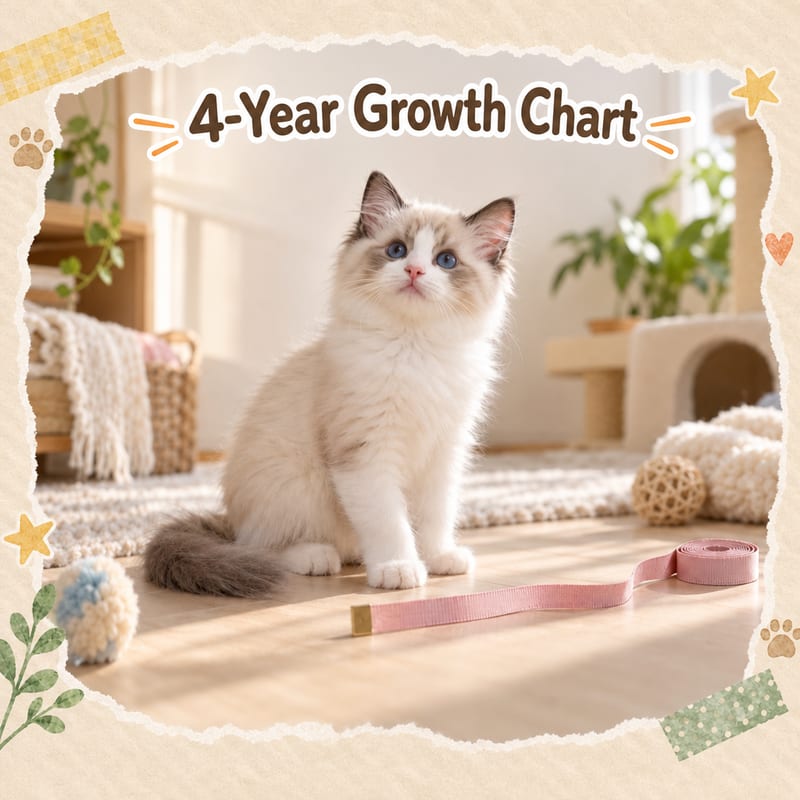
Body condition score (BCS): the tape measure is more accurate than a number
The internationally used feline body condition score uses a 1–9 scale, with 4–5 being ideal. Here are three steps for you to self-check at home:
- Feel the ribs: Gently part the fur; you can feel the ribs with your fingers but not see them—normal. If you have to press firmly to feel them—overweight; if you can see each rib even when walking—underweight.
- Waist from above: Standing directly above, a slight tuck behind the ribs (waist) is normal; if the body is round like a barrel, reduce food; if you can see bones and pelvis, investigate.
- Belly from the side: A moderate primordial pouch (loose skin on the lower abdomen) is normal anatomy for Ragdolls, but a wobbling water-bag feel and a thick, waistless middle are signs of overweight.
Long-term risks of overweight—diabetes, joint strain, urinary problems, and reduced ability to groom—are consistently described in veterinary literature; and once a large breed like the Ragdoll becomes overweight, the absolute load on the joints is greater than for a small cat. 'Big' and 'fat' are two different things, and the assessment standard is the three steps above.
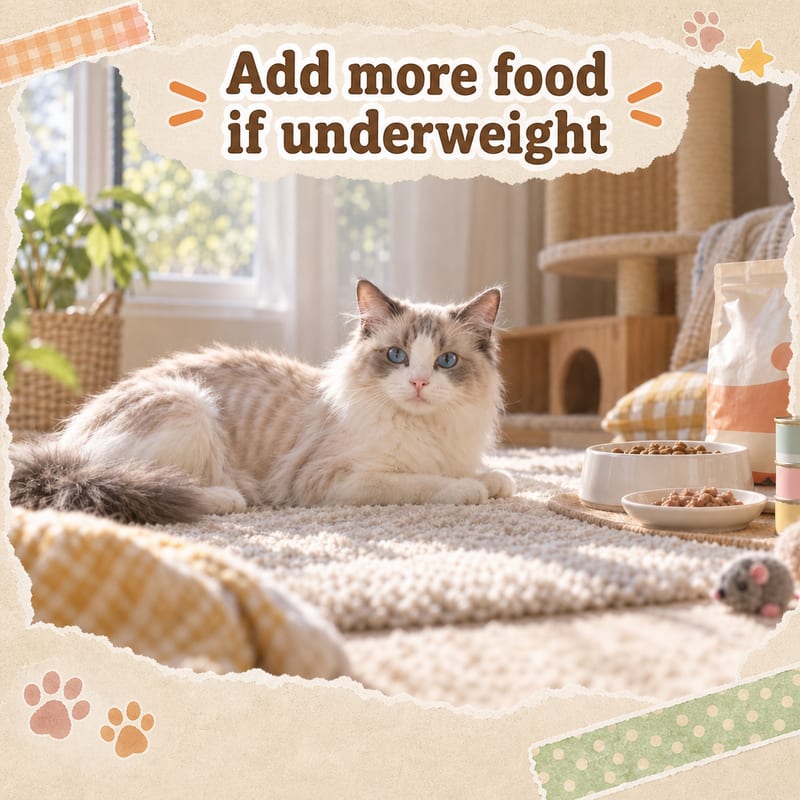
How to catch up if underweight: find the cause first, then increase food
If the curve is flat before two years old, or an adult suddenly loses weight, find the cause before adding food:
- Parasites: Faecal testing is recommended for newly arrived kittens; deworming according to the veterinarian's plan.
- Food competition: In multi-cat households, feed at separate locations; Ragdolls are gentle by nature and often lose out.
- Bowl placement: Too close to the litter box, narrow passages, or bowls that are too deep and touch the whiskers can all reduce eating.
- Disease signals: A sudden increase in water intake accompanied by weight loss is a combination that requires seeing a veterinarian as soon as possible; do not just observe and wait for the next health check.
Direction for increasing food: Choose kitten food or all-life-stages food with complete nutritional labelling, feed small meals more often, and mix wet and dry to increase total calories and water intake. Do not turn extra meals into 'free feeding'—the appetite of a neutered large cat is a curve killer.
Height and length: three sets of numbers beyond weight
A large cat's 'largeness' is not just about weight; you only feel it when you measure:
- Body length: From breastbone to tail base, adult Ragdolls can reach 40–50 cm, and with the tail the total length can approach one metre—this number directly determines the minimum size for cat beds, carriers, and car back seats.
- Shoulder height and standing height: Shoulder height when standing on four legs is about 25–30 cm; when standing on hind legs, the front paws can easily reach a normal tabletop, so do not leave food or pills on surfaces that 'look high but are just one stretch away'.
- Head circumference: After two years old, male cats' cheek muscles and neck ruff thicken noticeably, making the head look a size larger than the actual bone frame; do not double the feeding just because 'the head looks big'.
Use a soft tape measure, and record quarterly along with weight. Body length data is also useful for judging whether a kitten is 'thin or just not yet filled out': if both height and weight lag behind, that is a sign of a growth problem; if only weight is low but body length is normal, it is mostly a small frame or insufficient muscle mass.
Common questions about growth curves: all cleared up at once
- Is it normal for two brothers of the same age to have very different weights? Yes. The endpoint weight difference between Ragdoll lines can be 1–2 kg; after brothers are separated, each follows its own curve, and as long as each continues to rise, there is no need to worry.
- Do I need to switch food immediately after neutering? Not necessarily immediately, but start counting calories. Basal metabolism drops after neutering, and free-feeding usually shows weight creeping up within one to three months after surgery; switching to measured feeding at that point is easiest.
- Should I see a vet if the cat eats a lot but does not gain weight? If energy, stool, and appetite are all normal but there is zero growth for a month, a faecal test and basic blood tests are recommended to rule out parasites and absorption problems; do not add egg yolk or chicken to chase weight on your own—the stomach cannot handle it first.
- Is it a joke or everyday life that overweight pets are taken to the vet after New Year? Everyday. Extra meals and human snacks during holidays (ham sausage, too many dried fish) are common triggers for acute pancreatitis and gastrointestinal obstruction in cats. Ragdolls eat well and never refuse, so owners must be the gatekeepers for holiday treats.
Key summary
- ✅ Ragdolls are a large breed: males 6–9.5 kg, females 4.5–7 kg are the general endpoint ranges.
- ✅ They mature at 3–4 years; assessing with a short-haired cat timetable will lead to misjudgement.
- ✅ Weigh monthly under the same conditions + BCS body condition score; both tracks together are effective management.
- ✅ At 6 months about 2.5–4 kg; the key is a continuously rising curve, not a single point.
- ✅ Overweight increases joint, diabetes, and urinary risks; if underweight, first check for parasites and disease, then adjust feeding.
- ✅ A sudden increase in water intake with weight loss is a signal to see a veterinarian immediately.
Related reading
- Ragdoll lifespan and longevity guide
- Ragdoll disadvantages and how to cope
- Key points for keeping Ragdolls in Hong Kong
- For large home items and measured feeding: visit PetChill pet supplies for large cat trees, large litter boxes, and measured feeding bowls.
The weight ranges in this article are general references and do not constitute a diagnosis; if the growth curve is abnormal or weight changes suddenly, please consult a registered veterinarian.